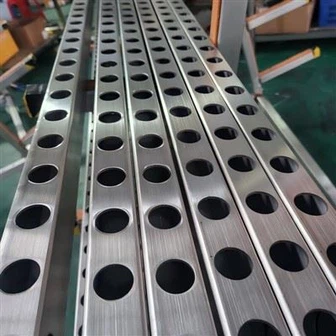
Why Do 316 Liquid Cooling Pipe Orders From Different Mills Vary in Price So Much?
A procurement manager in Singapore recently received three quotes for the same 316L liquid cooling pipe specification: $4.2/kg from one mill, $7.8/kg from another, and $11.5/kg from a third. All three claimed ASTM A312 compliance. The buyer's first instinct was to ask which mill was overcharging.
That instinct is wrong.
The real question is not which price is fair. It is which product will be cheapest over a 10-year cooling system lifecycle. The gap between those quotes comes down to four controllable factors: how the mill buys raw material, how it welds, how it finishes the inner bore, and how it tests the finished tube.
| Price Factor | Low-Cost Mill Approach | Precision-Cooling Mill Approach | Impact on Your System |
| Raw material sourcing | Uncertified coils from spot market | Certified 316L coils with mill test certificates, spectrometer-verified per batch | Guaranteed corrosion resistance vs. pitting risk in glycol-based coolant |
| Welding process | Manual TIG with variable heat input | Controlled orbital welding under ISO 3834 procedures | Weld consistency determines leak probability |
| Inner surface finish | Pickled only, Ra 1.6–3.2 μm | Polished + passivated to Ra ≤0.4 μm | Rougher surface traps particles, accelerates coolant degradation |
| Final inspection | Visual check + sample hydrotest | 100% dimensional, weld inspection, and leak testing | Detection rate for defects directly impacts field failure risk |
The Hidden Driver: Liquid Cooling Is Not General Industrial Piping
Standard 316 stainless pipe for a chemical plant faces different demands than 316L tubing for an AI server rack. General industrial lines tolerate minor weld bead protrusions, surface roughness around Ra 3.2 μm, and batch-to-batch dimensional drift within ASTM tolerances. Coolant loops do not.
A 0.1 mm outer diameter deviation that passes ASTM A312 can still prevent a fitting from sealing in a compact CDU manifold. A weld root that would survive 20 years in a steam line can shed particles into a precision coolant loop and clog microchannels within months.
Buyers frequently discover this after the first batch fails installation. One customer in our experience ordered 3,000 tubes from a low-cost supplier. The first 500 installed successfully; the remaining 2,500 had average outer diameter drift of 0.15 mm beyond the drawing tolerance, requiring on-site rework that erased the initial 15% price saving.
The Four Cost Drivers, Explained with Evidence
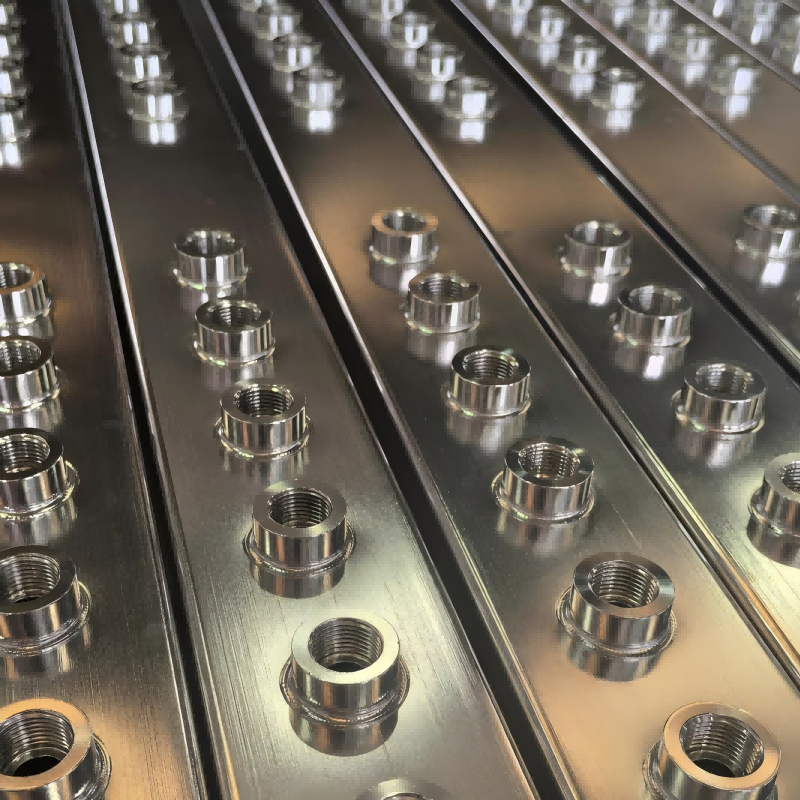
Driver 1: What the Mill Does With the Raw Coil
A mill quoting $4.2/kg typically sources 316L coils without full mill test certificates, betting that the chemical composition falls within spec. When it does not - particularly on molybdenum content, which drives corrosion resistance - the result is premature pitting in chloride-containing coolants.
Certified mills like China Super Tech verify every incoming batch through spectrometer testing and material certification review before production. That verification adds roughly 3–5% to material cost. It also removes the risk of a 20-ton batch failing after installation, at which point replacement cost exceeds the original order value by a wide margin.
The practical question for a buyer is not whether the coil has a certificate. It is whether the mill verifies that the certificate matches the physical material. Under ISO 9001 procedures, every batch is retained for traceability, and quality disputes stay verifiable rather than devolving into finger-pointing.
Driver 2: Welding Control Determines Leak Probability
The largest single cost gap between mills sits in the welding department. Manual TIG welding costs less per meter but introduces human variation in heat input, travel speed, and filler wire alignment. Orbital welding equipment automates these variables, producing consistent weld penetration across every joint.
Welding defects are the primary cause of coolant leakage, and leakage is the primary operational risk in liquid cooling systems. A single pinhole leak in a server rack can shut down an entire row of GPUs. China Super Tech applies ISO 3834-certified welding procedures, including orbital welding, paired with 100% leak inspection before shipment.
A mill running orbital welding passes that capital cost into the unit price. A buyer pays for that control either upfront or later through field failure - and field failure in a data center costs far more than the weld premium.


Driver 3: Internal Surface Finish Is a Long-Term Performance Decision
The inner bore of a cooling tube directly contacts the coolant. Surface roughness dictates how easily particles adhere, how turbulent the flow becomes, and how quickly the coolant degrades.
Conventional industrial tubing ships with inner surface roughness of Ra 1.6 to 3.2 μm - acceptable for closed loops with aggressive filtration. Precision liquid cooling demands cleaner surfaces. China Super Tech achieves internal roughness down to Ra ≤0.4 μm through polishing, pickling, and passivation.
- Polishing removes weld spatter and surface inclusions that could detach into the coolant stream
- Pickling dissolves the chromium-depleted layer left by welding, restoring corrosion resistance
- Passivation rebuilds the protective oxide film, ensuring long-term stability in glycol-based coolants
The cost difference between Ra 3.2 μm and Ra 0.4 μm is measurable but modest - typically 5–8% of unit price. The performance difference over 5 years is significant: smoother surfaces reduce particle accumulation, extend coolant replacement intervals, and protect downstream components like pumps and cold plates.
Driver 4: What "100% Inspection" Actually Means at Each Mill
Every mill claims quality control. The inspection scope differs dramatically. Some mills sample-test 5% of production. Others test every tube dimensionally, verify every weld, and pressure-test every unit before packaging.
China Super Tech runs multi-stage quality testing: incoming material inspection, dimensional measurement, welding inspection, surface verification, and leakage testing on every product before shipment. Annual capacity of 12,000 tons means three parallel orders can run without queuing - urgent demand ships in days, not months.
The price difference between sample testing and 100% testing narrows to pennies per kilogram. The risk difference is categorical.

How to Compare 316 Liquid Cooling Pipe Quotes Without Getting Misled
Use this checklist when evaluating supplier quotes. It turns an opaque bidding process into a structured comparison.
- Request the material mill test certificate for the specific batch that will ship to you, not a generic sample - then verify molybdenum content meets 316L spec for your coolant chemistry
- Ask which welding process will be used on your order - if the answer is manual TIG, request the welder certification records and confirm weld procedure specifications exist
- Specify inner surface roughness in your RFQ, and ask how it will be measured - surface roughness testers and visual inspection standards differ between mills
- Demand the inspection protocol as a written document before you place the order - confirm whether testing covers 100% of tubes or a statistical sample
- Compare the cost of a rejected batch against the price difference - a batch with 5% dimensional rejects wipes out a 10% price advantage
- Ask for a batch consistency reference from the mill - whether quality metrics from shipments over the past 12 months show stable results or variation
What Total Project Cost Looks Like When You Factor Quality In
| Cost Component | Low-Priced Supplier | Precision-Cooling Supplier |
| Unit price (per kg) | $4.2 | $7.8 |
| Installation rework rate | 8–12% of tubes needed rework | Below 0.5% |
| Field leakage incidents (3-year horizon) | 2–4 per 1,000 connections | 0 per 1,000 connections |
| Coolant replacement interval | 12–18 months | 24–36 months |
| 5-year total cost per 1,000 tubes | $86,000–$104,000 | $92,000–$97,000 |
The total cost curves converge because the lower-priced supplier's savings evaporate through rework labor, replacement coolant, downtime, and the engineering hours spent troubleshooting dimensional mismatches. For one Saudi cooling system integrator, switching from a low-cost mill to China Super Tech reduced their installation rejection rate from 9% to 0.3% within two batches.
A procurement lead at a German data center infrastructure firm put it directly:
"The biggest concern is not the sample quality, but whether every batch can maintain the same standard. We care more about total project cost than the price per meter."
When the Higher Quote Is the Cheapest Option
The $11.5/kg quote includes controlled welding, Ra ≤0.4 μm internal finish, 100% leak testing, documented traceability, and a 24-hour engineering response for custom geometry. If you are building AI server racks where a leak means downtime measured in hundreds of thousands of dollars per hour, that premium is the cheapest insurance available.
Suppliers without in-house testing may miss batch defects that surface only after installation. A mill with integrated manufacturing - from raw material inspection through forming, welding, surface treatment, and assembly - can respond faster to drawing reviews and production adjustments, shortening development cycles for custom manifolds and bent tubes.
At China Super Tech, 11+ years of manufacturing experience, exports to 20+ countries, and support for 600+ customer projects mean batch consistency is a documented record, not a promise. If your project needs 316L liquid cooling pipe with verifiable quality control, send your drawing and specification for a detailed quote that separates material cost, process cost, and inspection cost - so you can see exactly what you are paying for.
FAQ
Q1: Why is a 316L liquid cooling pipe more expensive than standard 316 stainless pipe?
A: Standard 316 pipe is manufactured to general industrial specifications, with surface roughness around Ra 3.2 μm and conventional welding control. Liquid cooling pipe requires internal surface treatment down to Ra ≤0.4 μm, controlled welding processes such as orbital welding, and 100% leak inspection before shipment. These additional process steps add manufacturing cost but directly reduce contamination and leakage risks in cooling systems.
Q2: What causes batch-to-batch dimensional variation between different mills?
A: Dimensional variation typically traces to raw material sourcing and forming equipment calibration. Mills using uncertified coils may receive material with slightly different mechanical properties between batches. Tube forming equipment that is not regularly calibrated produces drift in outer diameter and wall thickness. A mill with ISO 9001 processes and integrated in-house manufacturing maintains tighter control across both material verification and production monitoring.
Q3: How does inner surface roughness affect liquid cooling system performance?
A: Rougher inner surfaces (Ra above 1.6 μm) create turbulence pockets where particles accumulate and coolant degradation accelerates. Over months of operation, these particles can clog microchannels in cold plates or wear pump seals. A surface finish of Ra ≤0.4 μm keeps the flow path smooth, reducing particle adhesion and extending coolant replacement intervals from roughly 12 months to 24–36 months.
Contact Us
Tel/Fax: +86 139 1179 7578
WhatsApp/WeChat: +86 159 0035 7871
Email:
QR code: