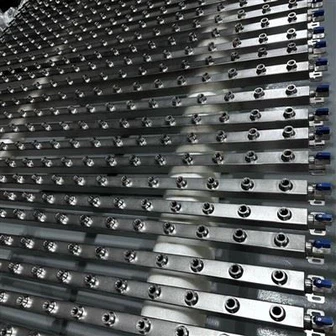
Don't Let An Improper 316 Liquid Cooling Pipe Bend Ruin Your Fluid Dynamics
A 316 liquid cooling pipe that leaves the bender with a wrinkled inner wall or a flattened oval cross-section does not announce itself. It ships clean, looks fine in a crate, and only reveals the damage when your coolant loop runs hot. That is the failure mode most buyers never inspect for - and it starts at the 316 liquid cooling pipe bend.
What a Bad 316 Liquid Cooling Pipe Bend Actually Costs You
A bend is where fluid dynamics gets tested hardest. Coolant entering a curve accelerates on the outer wall and slows on the inner wall. When the bend geometry is wrong, that velocity gap turns into turbulence, trapped air, and hotspots your thermal model never predicted.
Three failure signatures show up repeatedly on improperly bent 316 liquid cooling pipe:
- Inner-wall wrinkling raises local roughness, and turbulent flow drives pressure drop above the design point your pump was sized for.
- Ovality at the bend reduces the effective flow area, so your coolant velocity at the cold plate falls below the threshold needed to carry heat away.
- Wall thinning on the outer radius from over-stretching leaves a thinner section than the straight run - the exact spot where chloride pitting in glycol coolant begins.
If any of these sound familiar, this is the problem precision-bent 316 liquid cooling pipe is engineered to remove at the source.
Why 316 Liquid Cooling Pipe Bending Is an Engineering Decision, Not a Fabrication Task
The material you chose for the straight run is not the whole story. Molybdenum and low-carbon chemistry in 316L resist pitting in chloride-bearing glycol, but a bend that thins the outer wall or wrinkles the inner surface defeats that alloy advantage locally. Fluid performance lives or dies at the curve.
Here is what separates controlled bending from ordinary tube bending for coolant service:
- Mandrel support inside the tube keeps the inner wall smooth and holds ovality down through the arc, so the flow path stays round where velocity peaks.
- Wall-thickness tracking across the bend confirms the outer radius does not thin below your pressure margin - verified per ASTM A312 dimensional limits on the straight run, with bend geometry matched to the same standard.
- Orbital welding at the bend-to-fitting joint, managed under ISO 3834, holds weld consistency where a leak would take down a whole rack.
One difference worth pausing on: a minor wrinkle you can see is often the tip of a contour error you cannot. Roughness and ovality both degrade heat transfer before anything visually fails. "We are currently upgrading our AI server racks, and leakage is one of our biggest concerns," one data center infrastructure lead told our engineers. A bend that holds its geometry is the first line of defense.

The Real Cost of a 316 Liquid Cooling Pipe Bend That Fails After Installation
Consider how the cost stacks. A bend is a small fraction of the tube price. The consequence of getting it wrong is not.
Failure is not discovered at the bench. It appears as a slow pressure drift, a puddle under a manifold, or a joint that weeps after weeks of thermal cycling. By then the system is installed, the rack is populated, and the fix means draining the loop, breaking connections, and re-qualifying the assembly.
This is where batch consistency decides your total cost. A supplier whose sample bends pass inspection but whose production bends drift in outside diameter, wall thickness, or bend radius forces rework into your assembly line. As one procurement manager put it: "The biggest concern is not the sample quality, but whether every batch can maintain the same standard."
How China Super Tech controls that risk on every 316 liquid cooling pipe:
- Incoming material verification - each 316L heat is checked by spectrometer against its mill certificate before a single tube is formed.
- Dimensional control through forming and bending - outside diameter, wall thickness, and bend geometry are measured against drawing tolerance, not eyeballed.
- Internal surface treatment - polishing, pickling, and passivation bring inner roughness down to Ra ≤0.4 μm, so the bend does not become a particle trap.
- 100% leak inspection before shipment - every bent tube is pressure and leak tested, so a weeping joint never reaches your site.
Material and inspection records travel with the shipment, which shortens the supplier audit many buyers get stuck on. A ISO 9001 certified supplier should provide both the product and the complete quality documentation to prove it.
How to Specify a 316 Liquid Cooling Pipe Bend So It Holds Its Geometry
You do not need to become a tube-bending specialist. You need to specify four things clearly, and confirm your supplier can hold them.
| Specification | What to control | Why it protects your loop |
| Bend radius (CLR) | Minimum centerline radius for your OD | Too tight a radius forces wall thinning on the outer arc |
| Ovality at bend | Max % deviation from round | Preserves effective flow area and coolant velocity |
| Wall thickness after bend | Minimum retained wall on outer radius | Keeps the pressure margin your design assumed |
| Inner surface finish | Ra value at the bend | Prevents turbulence and particle accumulation |
Put these on the drawing. A supplier who can quote against all four is a bending partner; one who quotes only the tube OD is a tube vendor.
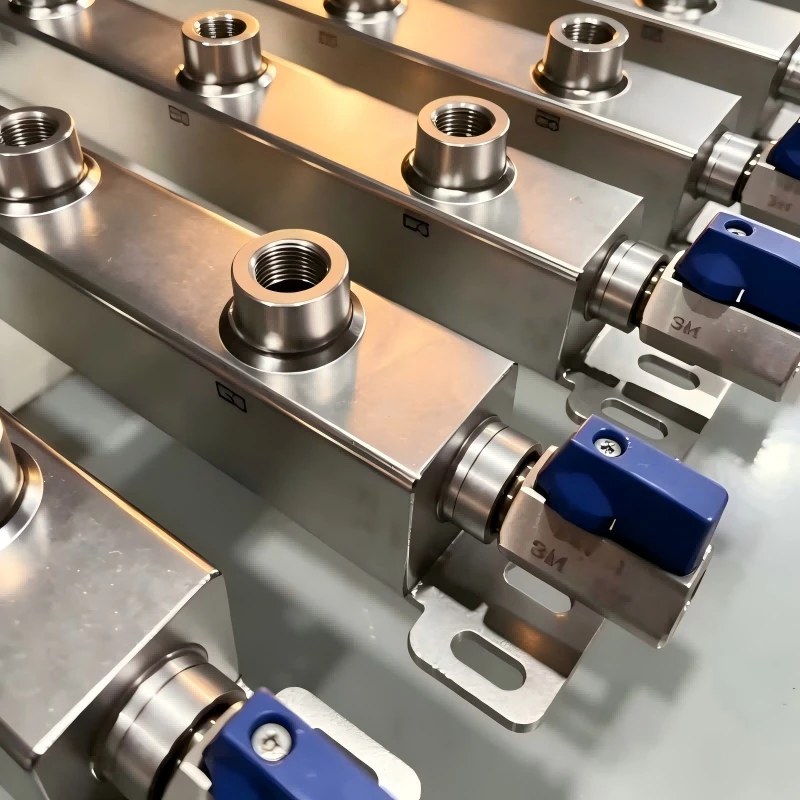
Our manufacturing supports customized 316 liquid cooling pipe from 10×10 mm to 80×80 mm square sections, 0.5–3.0 mm wall thickness, and lengths up to 6000 mm, with bent tubes and manifolds built to drawing. With 12,000 tons of annual capacity, a large bent-tube order slots into parallel production lines without pushing your lead time from 7 days into a 21-day queue.

Choosing a 316 Liquid Cooling Pipe Supplier for Bends You Can Trust
Bending quality is a manufacturing-capability question, not a pricing question. Three checks separate the two.
First, ask who performs the bending. In-house forming and bending under one roof removes the coordination gap where a supplier blames an outside bender and nobody owns geometry. China Super Tech runs material inspection, forming, bending, welding, surface treatment, and final inspection in-house.
Second, ask how weld and bend quality are verified. Bending and welding are the two process steps where coolant leaks originate. ISO 3834 welding management plus 100% leak inspection before shipment closes both.
Third, ask for the documentation before you ask for the price. Under ISO 9001, material certificates, dimensional records, and leak-test results are standard outputs - not favors. Over 11 years and 20+ countries, projects that require a clean audit trail are routine here, and a technical engineer replies to drawing questions within 24 hours.
Practical Steps to Prevent a Bending Failure on Your Next Project
- Put bend radius, ovality limit, retained wall thickness, and inner-surface Ra on the drawing - all four, not just OD.
- Request bend samples with dimensional reports before approving a full run.
- Confirm the supplier bends and welds in-house, and inspect the weld process control they cite.
- Require 100% leak-test records with each shipment, not a sample report.
- Match material to coolant - 316L for glycol and chloride-bearing loops; 304 for pure and deionized water.
Common Questions About 316 Liquid Cooling Pipe Bends
Q: What causes an oval or wrinkled 316 liquid cooling pipe bend?
A: Insufficient internal mandrel support during bending is the usual cause. Without a mandrel holding the inner wall, the tube collapses toward the neutral axis, producing ovality and inner-wall wrinkling. Controlled bending with mandrel support keeps the cross-section round and the inner surface smooth through the arc, preserving flow area and coolant velocity at the cold plate.
Q: Does bending weaken 316 liquid cooling pipe?
A: Bending thins the outer wall and can work-harden the material locally. The risk is manageable when the process controls retained wall thickness and holds bend geometry to drawing. Verify retained minimum wall on the outer radius against your pressure margin, and confirm the bend is inspected per the drawing - the straight-run limits are governed by ASTM A312, and the bend must hold equivalent integrity.
Q: Can you bend 316 liquid cooling pipe to my custom radius and length?
A: Yes. We produce bent tubes and manifolds to drawing, supporting 10×10 mm to 80×80 mm square sections, 0.5–3.0 mm wall thickness, and lengths up to 6000 mm. Send your drawing with bend radius and geometry and our engineering team reviews it before production, with a 24-hour response on technical questions.
Q: How do you prevent leaks at the bend-to-fitting weld?
A: Welding is controlled under ISO 3834, using orbital welding technology for consistent penetration, and every bent assembly receives 100% leak inspection before shipment. This closes the two highest-risk leak points in a coolant loop - the bend and the weld joint - so a defect is caught at our floor, not at your rack.
Q: What inner surface finish should a liquid cooling bend have?
A: For precision cooling, target internal surface roughness as low as Ra ≤0.4 μm. A smoother bend surface reduces particle accumulation and keeps coolant circulation stable. Our polishing, pickling, and passivation process reaches this finish, which matters most at the curve where flow accelerates and contamination is most likely to settle.
Get Your 316 Liquid Cooling Pipe Bent Right the First Time
One bend is a small line item. A failed bend is a drained loop, a re-qualified assembly, and a project timeline you cannot recover. The gap between those two outcomes is process control you can verify.
Send us your drawing - bend radius, ovality limit, retained wall, and inner-surface Ra - and a manufacturing engineer reviews it and replies within 24 hours. We will confirm feasibility, propose the bend geometry, and quote bent 316 liquid cooling pipe to your specification, with material certificates and leak-test records included.
Ask for bend samples with dimensional reports. Test the geometry before you commit the order.