


Liquid Cooling Quick Disconnect
LIQUID COOLING COMPONENT Liquid Cooling Quick Disconnect A stainless steel fluid connector assembly engineered for leak-free coupling and decoupling in closed-loop thermal management systems, including AI data centers, CDU racks and energy storage cabinets. Available in 304 and 316L stainless...
Product Introduction
Liquid Cooling Quick Disconnect
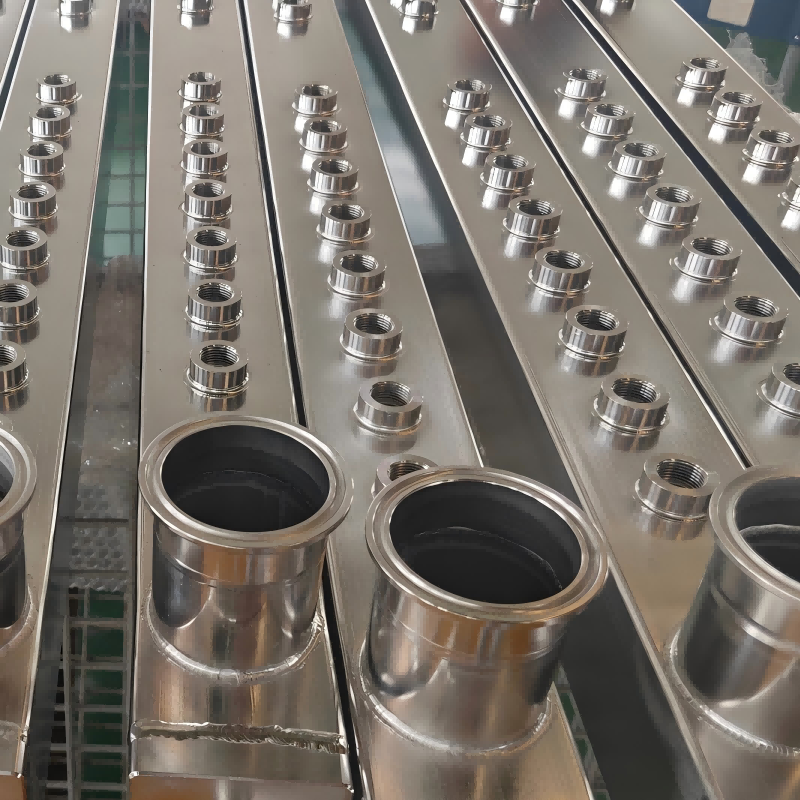
A stainless steel fluid connector assembly engineered for leak-free coupling and decoupling in closed-loop thermal management systems, including AI data centers, CDU racks and energy storage cabinets.
Available in 304 and 316L stainless steel, with internal surface roughness down to Ra ≤0.4 μm, orbital-welded joints and 100% pre-shipment leak inspection.
Where Liquid Cooling Quick Disconnects Can Fail
The coupling point is one of the most sensitive areas in a liquid cooling loop. Buyers need to consider leakage, dimensional consistency, internal cleanliness and delivery reliability before installation.
Leakage After Thermal Cycling
Coolant can drip at the coupling joint after repeated thermal cycling. A leak near a server rack may require a rack shutdown and coolant cleanup.
Dimensional Drift
Variation in outer diameter or wall thickness between production batches can affect mating hardware and increase on-site rework.
Internal Particle Shedding
Rough internal surfaces can retain particles that migrate into CDU loops, affecting coolant cleanliness and long-term system performance.
Project Delivery Delays
When connectors arrive after the installation schedule, the cooling installation team may be forced to wait or re-plan the project.

What Matters When Selecting a Quick Disconnect
A quick disconnect is not only a connection fitting. Its dimensional consistency, weld quality, internal finish and material selection affect how reliably the complete liquid cooling loop can be assembled and operated.
For projects that also require integrated coolant distribution, see the 316 Liquid Cooling Manifolds and Data Center Liquid Cooling Manifold Pipe .
The quick disconnect can be integrated with custom bends, manifolds and liquid cooling assemblies according to the project drawing.
Manufacturing and Quality-Control Comparison
| Dimension | This Product | Industry Conventional | Practical Value |
|---|---|---|---|
| Internal surface roughness | Ra ≤0.4 μm, polished, pickled and passivated | Ra 1.6–3.2 μm as-rolled tubing | Lower surface roughness can reduce particle entrapment |
| Welding quality control | ISO 3834, orbital welding and 100% leak inspection | Manual TIG and sample-based leak checking | Every unit is inspected before shipment |
| Batch dimensional consistency | In-house forming and dimensional inspection | Mixed in-house and outsourced processes | Supports repeat-order compatibility |
| Material options | 304 / 316L stainless steel | 304 standard only | 316L option supports chloride-bearing environments |
| Custom geometry | 10×10 to 80×80 mm square tube, 0.5–3.0 mm wall, up to 6000 mm | Standard straight tube | Custom bends and manifolds can reduce field modification |
| Manufacturing integration | Forming → welding → surface treatment → machining → inspection → assembly | Multi-supplier process | Fewer coordination points during custom production |
Manufacturing and Inspection Process
The product is controlled from material verification through final leak inspection. Orbital welding provides controlled weld penetration around the joint, while surface treatment and inspection address internal cleanliness and sealing requirements.
Spectrometer chemical composition check for each 304/316L batch.
Control dimensions, wall thickness and geometry during production.
Controlled welding process managed under ISO 3834.
Polishing, pickling and passivation to Ra ≤0.4 μm.
Dimensional, welding, surface and 100% leak inspection before shipment.
Technical Specifications
| Category | Parameter | Value | Standard |
|---|---|---|---|
| Dimensional | Square tube size | 10×10 to 80×80 mm | Custom |
| Dimensional | Wall thickness | 0.5–3.0 mm | Custom |
| Dimensional | Length | Up to 6000 mm | Custom |
| Surface | Internal roughness | Ra ≤0.4 μm | Internal specification |
| Material | Grade | 304 / 316L stainless steel | ASTM A312 |
| Material | 316L pitting resistance | Mo-bearing low-carbon stainless steel | ASTM A312 / JIS G3459 |
| Mechanical | Welding process | Orbital welding, ISO 3834 | ISO 3834 |
| Mechanical | Leak test | 100% pre-shipment inspection | Internal specification |
| Chemical | Composition verification | Per-batch spectrometer | ASTM A312 |
304 or 316L: Which Material Fits the Loop?
The material choice depends on coolant chemistry and operating conditions. 316L contains molybdenum and uses a low-carbon composition, making it suitable for loops where chloride exposure or higher pitting resistance is a concern.
For lower-corrosion indoor loops, 304 remains an available option. The manufacturer can review the coolant chemistry and application environment before recommending the material grade.
If the project also requires the main cooling pipe, see the Stainless Steel Square Liquid Cooling Pipe for Data Centers for compatible pipe configurations.
Customization Capability
| Custom Item | Range / Options | Verification |
|---|---|---|
| Tube geometry | Square 10×10 to 80×80 mm | Dimensional inspection |
| Wall thickness | 0.5–3.0 mm | Micrometer check |
| Length | Up to 6000 mm | Dimensional inspection |
| Bends & manifolds | Custom bends and liquid cooling assemblies | Drawing review + inspection |
| Material grade | 304 / 316L | Spectrometer per batch |
Customization process: Requirement confirmation → Drawing review and solution design → Prototype → Mass production → QC and delivery.
Application Scenarios
Build the Cooling Loop Around the Connector
A quick disconnect normally works as part of a larger cooling assembly. Depending on the system design, the connector can be matched with liquid cooling pipes, manifolds and custom distribution assemblies.
Liquid Cooling Connectors
Stainless steel connector assemblies for server liquid cooling, CDU systems and energy storage applications.
View Product →316 Liquid Cooling Pipe
316/316L stainless steel liquid cooling pipe options for high-density cooling systems and custom layouts.
View Product →316 Liquid Cooling Manifolds
Custom coolant distribution manifolds for AI data centers, CDU systems and energy storage loops.
View Product →Frequently Asked Questions
The stainless steel liquid cooling tube body and coupling are available in 304 or 316L stainless steel. The material is produced to ASTM A312 and JIS G3459. 316L contains molybdenum with a low-carbon composition, supporting higher pitting resistance in chloride-bearing coolant. Each raw material batch is verified by spectrometer before forming.
Internal surface roughness is controlled to Ra ≤0.4 μm through polishing, pickling and passivation. A smoother inner surface can reduce particle entrapment and support stable coolant circulation in precision CDU and rack cooling loops.
316L is considered when coolant or ambient conditions involve chlorides. Its molybdenum content and low-carbon composition provide higher pitting resistance than 304. For lower-corrosion indoor loops, 304 remains an available option. Material selection can be reviewed according to coolant chemistry and operating environment.
Welding is controlled under ISO 3834 using orbital welding to maintain consistent penetration around the joint. Each unit then undergoes 100% leak inspection before shipment. This full inspection approach is used because liquid cooling loops are leak-critical systems.
MOQ and lead time depend on whether the requirement is a standard or custom geometry. Standard tube orders generally move faster, while custom bends, manifolds and assemblies require drawing review and prototyping first. Share the specification, quantity and application so the engineering team can confirm the project requirements.
Yes. Custom bent tubes, manifolds and integrated liquid cooling assemblies are supported. The stated range includes square tubes from 10×10 to 80×80 mm, wall thickness from 0.5–3.0 mm and lengths up to 6000 mm.
Key Takeaways
Request a Liquid Cooling Quick Disconnect Quote
Send your required geometry, material grade, quantity and application. The engineering team can review the requirement and confirm the appropriate solution.
Hot Tags: liquid cooling quick disconnect, China liquid cooling quick disconnect manufacturers, suppliers, factory, efficient condenser tubing
You Might Also Like


Send Inquiry
