


Liquid Immersion Cooling
Liquid immersion cooling is a thermal management method where IT equipment—typically servers—is fully submerged in a dielectric coolant that transfers heat away from components far more efficiently than air. Built to handle rising AI chip densities, this approach removes the need for fans and traditional air conditioning, letting data centers push rack densities from roughly 10 kW per rack toward 100 kW or beyond.
Product Introduction

Liquid immersion cooling is a thermal management method where IT equipment-typically servers-is fully submerged in a dielectric coolant that transfers heat away from components far more efficiently than air. Built to handle rising AI chip densities, this approach removes the need for fans and traditional air conditioning, letting data centers push rack densities from roughly 10 kW per rack toward 100 kW or beyond.
Instead of circulating chilled air through a room, immersion systems place heat-generating hardware directly into a bath of non-conductive fluid. Because liquids conduct heat roughly 1,000 times better than air, component temperatures drop with a fraction of the energy cost. Operators cut cooling power consumption by up to 90% compared to conventional HVAC setups, freeing that capacity for compute.
[Product image: full immersion cooling tank with server racks submerged in clear dielectric fluid]
ISO9001 | ISO14001 | ISO45001 | ISO3834 · 11+ years · 12,000 tons/year · 20+ countries · 600+ projects
[Request a Quote] - engineering reply within 24 hours
The Costs Hidden in Air-Cooled Infrastructure
- Power ceiling: Data centers that exhaust air cooling capacity hit a wall around 20-30 kW per rack. Adding more compute means building more space.
- Water consumption: Evaporative cooling systems draw tens of millions of gallons annually, straining local resources and inviting regulatory pressure.
- Thermal runaway risk: High-density GPU clusters generate localized hot spots that standard cooling was never designed to manage.
- Space underutilization: Air cooling demands wide aisles, sound attenuation, and ductwork-three design constraints immersion simply eliminates.
If these constraints look familiar, liquid immersion cooling was engineered to solve exactly these problems.
Liquid Immersion vs. Air Cooling - Where the Value Shifts
| Dimension | Liquid immersion cooling | Conventional air cooling | Differential value |
| Cooling medium | Dielectric fluid (direct contact) | Chilled air (indirect) | 1,000x higher heat transfer coefficient |
| Rack density supported | Up to 100 kW+ | 10-30 kW typical | 3-10x compute per square meter |
| Cooling power draw | Pumps only | Compressors + fans + chillers | 70-90% lower cooling energy |
| Thermal management precision | Component-level | Room-level | Consistent junction temperatures |
| Infrastructure complexity | Tank + CDU + pump | CRAC units, ducting, raised floor | Fewer moving parts, fewer failure points |
Not every facility should switch tomorrow. Edge sites with modest densities still run fine on air. But for AI training clusters, HPC research centers, and any workload pushing past 30 kW per rack, immersion is the difference between building one facility or three.
Manufacturers serve both worlds: facilities running traditional air systems deploy our 316L stainless steel liquid cooling tubes within CDU (coolant distribution unit) loops, while full-immersion deployments rely on the same tube infrastructure to move heat from the tank to the external heat rejection loop. The metal that carries coolant from the immersion tank to the heat exchanger matters as much as the tank itself-which is why fluid-compatible materials have become a core specification.
What Makes Cooling Fluid Safe for Direct Contact Hardware
The single biggest question buyers ask is the same one their insurers ask: what happens to electronics sitting in fluid for years? The answer starts with the fluid chemistry and ends with the materials that contain it.
| Property | Requirement for single-phase dielectric coolant | Why it matters |
| Dielectric strength | > 40 kV (ASTM D877) | Prevents electrical shorts across energized components |
| Kinematic viscosity | 1-5 cSt at 40°C | Thin enough to flow through tight server gaps |
| Material compatibility | No swelling or leaching per ASTM D471 | Seals, gaskets, and tubing stay stable for years |
| Thermal conductivity | > 0.1 W/m·K | Transfers heat from chip surface to fluid |
| Flash point | > 100°C (ASTM D92) | Eliminates fire risk at operating temperatures |
| Service life | 5-10 years betweenfluid replacement | Contains total operating cost |
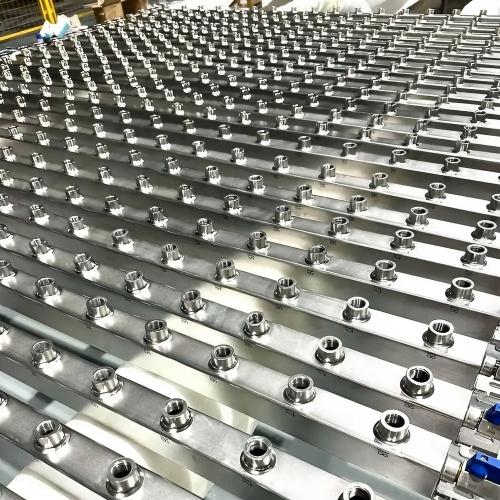
Two fluid families dominate the market. Synthetic esters (often PAO-based) offer high thermal stability and low toxicity, making them the preferred choice for large-scale AI facilities. Fluorinated fluids (like FC-40 or HFE variants) provide superior dielectric properties but carry a significantly higher price tag and a higher global warming potential. The industry has moved steadily toward esters as their performance envelope has widened and their cost advantage has compounded.
That fluid flows through a circulation loop that includes pumps, a CDU, and the tubing that connects tank to heat exchanger. Fluid in direct contact with hardware is non-conductive-but it also carries heat away to be rejected elsewhere. 316L stainless steel is the deployment standard for that loop because it resists the chloride pitting that can occur over years of fluid circulation, especially when esters break down into acidic byproducts under sustained thermal load.
316L Stainless Steel as the Fluid-Handling Standard
The cooling loop that carries fluid from tank to heat exchanger needs to hold pressure, resist corrosion, and maintain internal cleanliness for a decade or more. 316L stainless steel delivers on all three axes:
- Molybdenum content (2-3%): provides resistance to chloride pitting-critical because esters can form acidic compounds over years of operation
- Low carbon (0.03% max): prevents weld sensitization, so welded joints retain corrosion resistance comparable to the base metal
- Surface finish options: electropolished interior finishes down to Ra ≤0.4 μm reduce particle accumulation and keep coolant clean over extended service intervals
Holding this standard requires deliberate manufacturing discipline rather than generic tube production. China Super Tech Co., Ltd. operates under ISO 3834 welding certification, meaning every weld on a liquid cooling line follows documented procedures with a qualified operator behind it.
| Parameter | 316L immersion cooling tube specification | Verification method |
| Material grade | 316L per ASTM A312 / JIS G3459 | Spectrometer test per batch, MTR included |
| Surface roughness | Ra ≤0.4 μm internal | Per ISO 4287, contact profilometer |
| Welding | ISO 3834-certified procedures | Visual inspection + pressure test |
| Square tube range | 10×10 mm to 80×80 mm | Dimensional measurement per batch |
| Wall thickness | 0.5-3.0 mm | Micrometer sampling per lot |
| Length | Up to 6000 mm | Verified per production order |
| Leak integrity | 100% leak inspection before shipment | Air underwater test or helium leak detection |
Why Surface Finish Determines System Lifespan
Internal roughness below Ra 0.4 μm is not vanity polish. A smoother inner wall means fewer microscopic crevices for particles to settle into, which means:
- Lower particle shedding: Each circulation cycle carries fewer contaminants that could deposit on cold plates or chip surfaces
- Stable flow dynamics: Friction drops as roughness decreases, reducing pump energy draw over the system's lifetime
- Cleaner fluid for longer: Particulate contamination accelerates ester degradation; cleaner walls extend fluid service intervals
Manufacturers who skip the electropolishing step save 15-20% on production cost-and pass that cost to their customers in the form of early fluid replacement and unplanned maintenance. Facilities using highly polished 316L tubes commonly report coolant replacement intervals of 8-10 years.
The Weld Zone - Where Leaks Either Begin or Never Happen

Every welded connection on an immersion cooling loop is a potential failure point. A pinhole leak at 40-60 psi doesn't drip visibly; it atomizes coolant into the surrounding air, creating a slow loss that corrodes nearby components before anyone notices.
Orbital welding addresses this by automating the weld path with precision an automated arc cannot achieve by hand. The torch rotates 360° around the tube joint with consistent travel speed and arc length, producing uniform penetration across the entire circumference. When paired with ISO 3834-certified procedures, orbital welding reduces operator-dependent variability to near zero.
At China Super Tech, every welded cooling component passes a 100% leak inspection before shipment. The acceptance standard is not cosmetic-it is zero measurable leakage under test pressure. That procedure, documented and repeatable, is what separates liquid cooling components from general-purpose stainless tubes that happen to be sold into cooling projects.
| Dimension | China Super Tech capability | General tube mill baseline | Differential value |
| Internal roughness | Ra ≤0.4 μm via electropolishing | Ra 0.8-1.6 μm as-formed | 50-75% smoother flow path, fewer particles |
| Welding certification | ISO 3834 full process control | Often undocumented procedures | Audit-ready welding quality for CDU projects |
| Leak testing | 100% of components before shipment | Sample-based with no documented criteria | Zero-shipment-defect target for cooling loops |
| Dimensional range | 10×10 mm to 80×80 mm square, wall 0.5-3.0 mm | Standard round pipe only | Custom sections for space-constrained rack layouts |
| Manufacturing integration | Forming→weld→polish→machine→test in-house | Multi-vendor handoffs | Tighter tolerance chains, fewer coordination gaps |
| Lead time | 7-15 working days standard | 4-8 weeks typical from multi-step supply chains | Projects start on schedule |
Technical Specifications
| Category | Parameter | Value | Standard |
| Dimensional | Square tube size | 10×10 mm - 80×80 mm | Custom per drawing |
| Wall thickness | 0.5-3.0 mm | Custom per drawing | |
| Length | Up to 6000 mm | Custom per drawing | |
| Chemical | Chromium (Cr) | 16.0-18.0% | ASTM A312 |
| Nickel (Ni) | 10.0-14.0% | ASTM A312 | |
| Molybdenum (Mo) | 2.0-3.0% | ASTM A312 | |
| Mechanical | Tensile strength | ≥ 485 MPa | ASTM A312 |
| Yield strength | ≥ 170 MPa | ASTM A312 |
Customization Capability
- Cross-section geometry: square, rectangular, round per system design
- Custom ends: flared, threaded, or prepared for orbital weld fittings
- Assembly options: bent tubes, manifolds, and complete coolant distribution sub-assemblies
- Surface finish: internal and external electropolishing to specified Ra values
- Documentation: full MTR, weld maps, and inspection reports per shipment
Liquid Immersion Cooling Applications
| Industry | Typical Application | Recommended Spec | Operating Environment |
| AI data centers | Coolant loop piping for single-phase immersion tanks | 316L square tube 40×40 mm, Ra ≤0.4 μm | Continuous 24/7 operation, dielectric fluid |
| HPC research centers | High-density GPU cluster cooling | 316L round tube, DN25-DN50 | Load-cycling thermal stress |
| Energy storage | Battery thermal management loops | 304 for pure water / 316L for glycol | Outdoor temperature swings |
| Edge computing | Compact immersion modules | Small-diameter 316L with tight bends | Space-constrained enclosures |
Customer Cases
- AI training facility · North America · 8,000 m of 316L square tubing · 2-year supply contract · zero weld failures reported to date - the operator's previous general-purpose tubing source delivered three weld failures in the first six months.
- CDU manufacturer · Europe · 1,200 custom manifolds per year · ongoing · leak test pass rate 100% at incoming inspection - replaced a three-vendor sourcing model that averaged 11 days of coordination lag per order.
- Energy storage integrator · Asia-Pacific · 5,000 bent tubes with custom ends · 18-month program · dimensional conformity 99.7% across all batches - a prior supplier's batch-to-batch variation forced on-site rework at the integrator's own cost.
- Immersion cooling startup · Scandinavia · prototype to production scale-up · 14-month cycle · same-spec performance from first sample to 10,000-unit order - engineering support during the design phase eliminated a costly manifold redesign.
Customer Voice
"A small leakage problem in liquid cooling can create a very expensive failure." - operations director, AI data center operator
Use case: evaluating welding quality procedures before committing to a 3-year cooling infrastructure supply agreement.
Customer testimonial quotes and extended case documentation: [Available on request for your verification]
FAQ
Q1: What is the difference between 316L and 304 stainless steel for liquid cooling loops?
+
-
A: 316L contains 2-3% molybdenum, which provides substantially better resistance to chloride pitting. Dielectric coolants-especially synthetic esters-can form acidic byproducts over years of operation, and 316L maintains its integrity in that environment. Per ASTM A312, 316L also has lower carbon (≤0.03%), preventing weld sensitization. For closed loops running pure water, 304 is a cost-effective alternative. For immersion cooling, where fluid replacement costs are high and service life targets exceed five years, 316L is the safer specification.
Q2: How does internal surface roughness affect coolant performance over time?
+
-
A: Rougher surfaces create micro-crevices where particulate matter settles and accumulates. Over thousands of circulation cycles, those particles can break loose and deposit on cold plates or chip surfaces, reducing heat transfer efficiency. Electropolished surfaces at Ra ≤0.4 μm eliminate most crevices, keeping coolant cleaner for longer periods. Operators commonly report coolant replacement intervals of 8-10 years on systems with polished 316L tubing-compared to 3-5 years with standard as-formed surfaces.
Q3: What welding certification should a liquid cooling component manufacturer hold?
+
-
A: ISO 3834 is the definitive welding quality certification for this application. It requires documented welding procedures, qualified operators, and a traceable quality management system for every weld produced. Per ISO 3834-2, manufacturers must demonstrate full process control from procedure qualification through final inspection. China Super Tech operates under ISO 3834 certification, backed by 100% leak inspection on every cooling component before shipment.
Q4: What is the typical delivery lead time for a custom liquid cooling tube order?
+
-
A: Standard product ships within 7-15 working days. Custom configurations-special dimensions, bent tubes, or full manifold assemblies-typically require 15-25 working days including drawing review and prototype approval. With 12,000 tons of annual capacity and integrated production from material inspection through final assembly, schedule certainty is contractual rather than estimated.
Q5: How much does a liquid immersion cooling system cost to operate versus air cooling?How do I get access to a theme l purchased?
+
-
A: The differential compounds year by year rather than settling at first glance. A detailed cost model depends on facility scale, but established industry data points are consistent: cooling power draw drops by 70-90% because compressors and fans disappear. Water consumption drops to near zero with evaporative cooling removed. Server density rises 3-10x per rack, cutting building footprint per kW of compute. The primary new operational cost is fluid-roughly 2-5% of system capex per year for top-up and eventual replacement. Buyer beware: ignoring fluid chemistry and tubing surface quality turns those savings into unplanned maintenance expenses.
Hot Tags: liquid immersion cooling, China liquid immersion cooling manufacturers, suppliers, factory, heat exchanger liquid pipe, industrial coolant pipe, long life cooling pipe, process condenser tube, seamless heat exchanger tubing, thermal exchange cooling pipe
You Might Also Like



Send Inquiry
