


Server Immersion Cooling
A server immersion cooling loop carries a brutal secret: the fluid that removes heat from your processors is also the most aggressive environment your cooling hardware will ever face. Dielectric coolant at 60°C circulating 24/7 attacks metal surfaces through electrochemical corrosion,...
Product Introduction

A server immersion cooling loop carries a brutal secret: the fluid that removes heat from your processors is also the most aggressive environment your cooling hardware will ever face. Dielectric coolant at 60°C circulating 24/7 attacks metal surfaces through electrochemical corrosion, particle erosion, and galvanic coupling. When a stainless steel tube fails inside a tank holding thousands of liters of coolant, you do not replace a pipe - you drain the tank, halt the rack, and explain to the CFO why 40 servers sat dark for 36 hours.
The manufacturer behind your immersion cooling tubes determines whether that scenario stays hypothetical. China Super Tech Co., Ltd. has spent 11+ years manufacturing stainless steel liquid cooling components, and its 304/316L tubes now circulate coolant in 20+ countries. The engineering decisions baked into those tubes - internal surface roughness, weld integrity, material traceability - decide your system's leak-free lifespan.
What Breaks First in an Immersion Cooling Loop
Immersion cooling concentrates every failure mode into one enclosed volume. Conventional data center piping spreads risk across hundreds of meters of tubing; immersion cooling compresses that risk into a few meters of tube inside each tank.
- Corrosion at the weld zone. Heat-affected zones around welds become anodic sites in dielectric coolant. Without proper passivation, chromium-depleted regions initiate pitting that grows invisibly for months before a pin-hole leak appears.
- Particle contamination from internal surfaces. Rough internal surfaces shed micro-particles that circulate through your CDU, accumulate on cold plates, and degrade heat transfer efficiency. Industry data indicates internal roughness directly correlates with particle generation rate in closed-loop systems.
- Galvanic corrosion between dissimilar metals. When tube material, fitting material, and manifold material differ in electrochemical potential, the less noble metal sacrifices itself. A system built from mixed-grade components corrodes at a predictable, measurable rate.
- Batch inconsistency. You qualify a supplier on sample quality. Then production batch #2 arrives with different wall thickness tolerance, different weld penetration, different surface finish - and your assembly line stops while engineers re-work fittings.
A petrochemical cooling fabricator in the Middle East learned this lesson after accepting a low-priced quote 15-20% below market for 316L tubes. The savings evaporated in rework, extra inspection costs, and a two-month project delay. The customer's own words: "The cheapest supplier is not always the most cost-effective choice. We care more about total project cost."
Why Internal Surface Finish Determines Coolant Lifespan
Inside an immersion cooling loop, the tube's internal surface is not a passive conduit - it is an active interface between metal and coolant. Every roughness peak is a potential nucleation site for particle attachment. Every valley shelters contaminants from the flow stream.
China Super Tech controls internal surface roughness to Ra ≤0.4 μm through polishing, pickling, and passivation. That number matters because of what it prevents:
- Particle shedding. Smoother surfaces release fewer particles into circulation, keeping coolant clean and protecting downstream components.
- Corrosion initiation. Passivation restores the chromium oxide layer removed during welding and forming, closing the electrochemical pathway that starts pitting.
- Flow consistency. Uniform internal geometry maintains predictable pressure drop across the loop, so your CDU pumps operate within design parameters.
A data center infrastructure lead evaluating cooling upgrades phrased the constraint precisely: "Our existing rack design has very limited installation space, and standard liquid cooling components don't fit." That space limitation pushes designers toward compact bends and custom manifolds - which pushes quality requirements upstream to the tube manufacturer.

Controlled Welding: Where Leak Prevention Actually Happens
Leakage ranks as the top operational fear in immersion cooling. One data center manager put it bluntly: "We are currently upgrading our AI server racks, and leakage is one of our biggest concerns. How do you make sure your tubes don't leak?"
The answer lies in welding process control, not post-weld miracles. China Super Tech operates under ISO 3834 welding quality certification - a standard that governs welder qualification, procedure specifications, and inspection documentation. For liquid cooling applications, they apply orbital welding technology, which automates the welding travel speed and arc positioning that human welders struggle to repeat consistently across hundreds of joints.
The quality chain works in layers:
- Raw material verification. Every 304/316L batch undergoes chemical composition inspection and material certification review before entering production.
- Dimensional control. Precision tube forming holds outer diameter, wall thickness, and geometry consistency so fittings seat correctly at assembly.
- Weld inspection. Controlled welding parameters plus visual and dimensional verification catch defects before they become leaks.
- 100% leak inspection. Every tube is pressure-tested before shipment - not a sampling rate, not an AQL plan, every single unit.
That final step matters more than any specification sheet. A sampling-based inspection regime accepts statistical risk; 100% testing eliminates it for the units you receive.
Custom Geometries for Real Rack Layouts
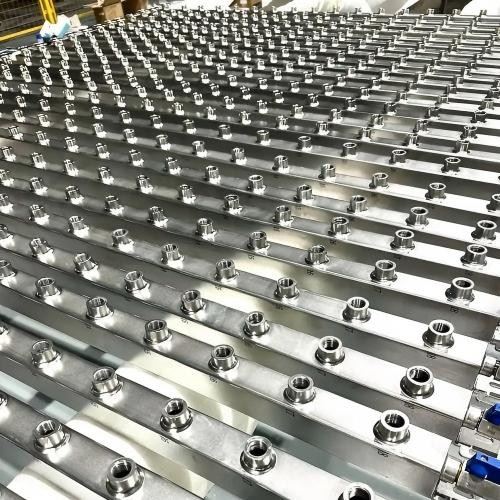
Immersion cooling tanks have unforgiving internal layouts. Pump placement, CDU connection points, and server tray spacing dictate tube paths that standard straight stock cannot serve. China Super Tech builds tubes to your geometry rather than forcing your design around standard products:
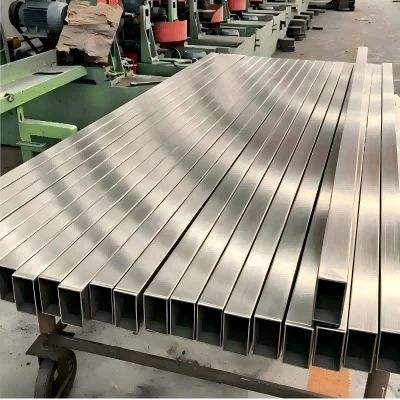
- Square tube cross-sections from 10×10 mm to 80×80 mm
- Wall thickness from 0.5 mm to 3.0 mm
- Lengths up to 6000 mm
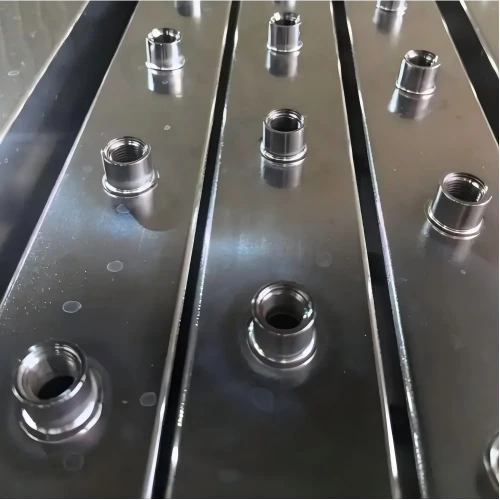
- Custom bends, manifolds, and integrated assemblies
Deep integration matters because every fitting joint is a potential leak point. A tube with integrated bends replaces two fittings and two weld joints with one continuous flow path. Fewer joints means fewer leak opportunities and less installation labor - a direct reduction in both risk and assembly cost.
The factory's integrated capability chain - forming, welding, surface treatment, machining, inspection, assembly - means your custom geometry never passes through multiple subcontractors who each add their own tolerance stack-up and coordination delay.

Industrial Capacity Behind AI-Scale Deployment
Immersion cooling at AI data center scale consumes tubing by the kilometer. A single large deployment may require thousands of tubes with consistent dimensions across every batch. China Super Tech's 12,000-ton annual production capacity means your order runs on dedicated lines without queue-jumping delays.
Eleven years of manufacturing experience and support for 600+ customer projects translate into production scheduling that absorbs urgent demand. When your project timeline accelerates - and it always does - the factory's inventory buffer and multi-line capacity allow expedited production without compromising the inspection steps that protect your system.
Certifications including ISO 9001, ISO 14001, ISO 45001, ISO 3834, CE, RoHS, and EU food-grade compliance cover the full compliance spectrum for international deployment. Your procurement team checks the boxes; the factory already met them.
Validating a Server Immersion Cooling Tube Supplier
Supplier verification for immersion cooling tubes requires asking questions that separate liquid cooling specialists from general stainless tube mills:
| Verification Question | What a Qualified Answer Looks Like |
| Internal surface roughness spec? | Ra ≤0.4 μm with passivation, backed by surface measurement reports |
| Welding quality system? | ISO 3834 certification with orbital welding capability, not just manual TIG |
| Leak testing protocol? | 100% pressure testing before shipment, not sampling |
| Material traceability? | Chemical composition verification per batch with certification review |
| Custom geometry support? | In-house bending, manifold fabrication, and assembly - not outsourced |
| Production capacity? | Dedicated lines with documented annual tonnage and inventory buffer |
Conclusion: Your Coolant Loop Is Only as ISO 9001 certified as Its Tubes
The tubes inside your server immersion cooling tanks carry the entire thermal load of your computing infrastructure. When they fail, servers stop, coolant drains, and uptime evaporates. China Super Tech has spent 11+ years manufacturing the stainless steel tubes that prevent that failure sequence - with controlled internal surfaces, certified welding processes, 100% leak inspection, and custom geometry built in-house.
Request a quote with your tube specification and quantity. A manufacturer engineer replies within 24 hours - not a sales representative, an engineer who understands immersion cooling loop requirements.
FAQ
Q1: What is the recommended material for server immersion cooling tubes?
A: 316L stainless steel is recommended for glycol-based coolants and demanding industrial environments due to superior corrosion resistance. 304 stainless steel offers cost-effective performance for pure water and deionized water systems. Your coolant chemistry determines the optimal grade - China Super Tech provides both options with full material certification.
Q2: What internal surface roughness can be achieved for immersion cooling tubes?
A: China Super Tech controls internal surface roughness down to Ra ≤0.4 μm through polishing, pickling, and passivation. This smoothness reduces particle shedding into the coolant loop and minimizes corrosion initiation sites, supporting stable coolant circulation over extended operation periods.
Q3: What welding standards apply to liquid cooling tube manufacturing?
A: China Super Tech operates under ISO 3834 welding quality certification, which governs welder qualification, procedure specifications, and inspection documentation. For liquid cooling applications, orbital welding technology is applied to achieve consistent weld penetration and reduce leakage risks from human operational variation.
Q4: How is leak prevention verified before shipment?
A: Every tube undergoes 100% leak inspection before shipment - not a sampling rate. Each unit is pressure-tested to verify weld integrity and wall soundness. This complete testing protocol, combined with controlled welding processes and dimensional inspection, minimizes installation risks for customers.
Q5: What custom tube geometries are available for immersion cooling systems?
A: Custom square tubes range from 10×10 mm to 80×80 mm, with wall thickness from 0.5 mm to 3.0 mm and lengths up to 6000 mm. Custom bends, manifolds, and integrated assemblies are manufactured in-house, enabling system designers to optimize piping layout and reduce joint count.
Q6: What production capacity supports large-scale AI cooling projects?
A: China Super Tech has 12,000 tons of annual stainless steel pipe production capacity with 11+ years of manufacturing experience. Products are supplied to customers in 20+ countries, supporting 600+ projects. This capacity enables stable supply for both large-volume orders and customized projects.
Hot Tags: server immersion cooling, China server immersion cooling manufacturers, suppliers, factory, alloy cooling pipe system, alloy smooth condenser tube, fluid cooling pipeline, high pressure liquid cooling pipe, industrial liquid cooling pipe, vapor cooling pipe system
You Might Also Like


Send Inquiry
