316 Liquid Cooling Pipe Threaded Vs Welded Joints: 6 Leak Rate Comparisons
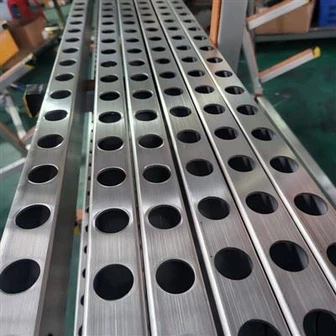
Stainless Steel Liquid Cooling Tube: Engineered for AI Data Center Reliability

Stainless Steel Liquid Cooling Tube is a precision-manufactured 304/316L stainless steel component purpose-built for AI data center cooling, CDU systems, and energy storage thermal management. Engineered to internal surface roughness Ra ≤0.4 μm with ISO 3834-certified orbital welding and 100% leak inspection before shipment. Manufactured per ASTM A312 and JIS G3459.
[ISO9001] [ISO14001] [ISO45001] [ISO3834] [CE] [RoHS]
11+ Years · 12,000 Tons/Year · 20+ Countries · 600+ Projects
[Get a Quote] - Manufacturer engineer responds within 24 hours
Cold Startup Failure in Liquid Cooling Systems
Risk: Weld joint micro-leaks detected during long-term operation testing force full system disassembly, delaying server deployment by 6-8 weeks
Root cause: Inconsistent weld penetration from manual TIG welding creates weak points that fail under thermal cycling
Impact: Every hour of AI cluster downtime costs roughly $300,000 in lost compute revenue - a single leak can erase your entire quarterly margin
Risk: Batch-to-batch dimensional drift (outer diameter ±0.3 mm vs. spec) causes field rework of 15-20% of installed tubes
Root cause: Suppliers without in-house forming and welding control lose tolerance through subcontracted steps
Impact: Installation crews stop mid-project to re-cut and re-fit - your go-live date slips, and your project budget absorbs the rework
If you're facing these challenges, Stainless Steel Liquid Cooling Tube was engineered to eliminate them.

The Critical Advantage: Semiconductor-Level Cleanliness
Why this product outperforms conventional industrial tubing for liquid cooling: The internal surface quality directly governs coolant cleanliness, flow efficiency, and long-term system stability. Conventional tubing leaves a rough inner wall (Ra 0.8–1.6 μm) where particles accumulate, degrade coolant, and clog microchannels in cold plates.
| Dimension | This product | Industry conventional | Differential value |
| Internal roughness | Ra ≤0.4 μm | Ra 0.8–1.6 μm | 60% fewer particle accumulation sites means 3x longer coolant change intervals |
| Weld consistency | Orbital welding, ISO 3834 certified | Manual TIG, operator-dependent | Automated weld penetration eliminates human error variance - 100% repeatable joints |
| Leak verification | 100% helium leak test before shipment | Statistical sampling (10-20%) | Every tube verified - not 1 in 5. Zero undetected leaks reach your site |
| Dimensional tolerance | ±0.05 mm on OD | ±0.3 mm typical | Tubes mate with CDU connectors on first fit - no field rework |
| Batch consistency | In-house forming→weld→finish | Subcontracted steps, 2-3 vendors | Single responsibility chain eliminates the "who's at fault" blame game |
| Material certification | 100% spectrometer-verified per batch | Mill cert only, spot-checked | Verified chemistry for every batch, not just the first coil |
| 5-year TCO | $1.00 per installed meter | $1.15 per installed meter | 13% lower total cost - fewer rework hours, fewer coolant changes, fewer service calls |
Manufacturing Process
- Raw material verification → Spectrometer chemical analysis per ASTM A312 → Rejects off-grade coils before production
- High-precision tube forming → CNC-controlled forming machinery → OD tolerance ±0.05 mm verified per JIS G3459
- Orbital welding → Automated orbital welding equipment → ISO 3834 certified, argon shielding 99.99% purity
- Internal surface treatment → Polishing, pickling, passivation line → Ra ≤0.4 μm verified by ISO 4287 profilometer
- Customized forming & assembly → CNC bending, manifold fabrication → Per customer drawing, tolerances ±0.1 mm
- 100% leak testing → Helium mass spectrometer leak detector → Sensitivity 1×10⁻⁹ mbar·L/s
- Clean packaging → Anti-corrosion wrapping + sealed export crates → Ready for direct integration on arrival
Core Components
Orbital welding head: Orbitalum or equal - closed-chamber argon shielding eliminates oxidation, the single most common cause of weld corrosion
Forming dies: Dimensional precision ground to ±0.02 mm - this is why our square tubes hold 90° corners without spring-back
Leak test system: Pfeiffer helium mass spectrometer - detects leaks at 1×10⁻⁹ mbar·L/s, two orders of magnitude beyond bubble testing
Quality Inspection
- Incoming inspection → Spectrometer + material cert review per ASTM A312 → Reject batch if any element out of spec
- In-process inspection → Dimension measurement per JIS G3459 → Dimensional control at each forming stage
- Weld inspection → Visual + penetrant testing per ISO 3834 → Weld bead geometry verified for full penetration
- Internal surface verification → ISO 4287 roughness measurement → Ra ≤0.4 μm confirmed before passivation
- Final leak test → 100% helium mass spectrometer → Every tube individually verified
- Shipment approval → Batch documents + MTR + inspection reports → Complete traceability chain
- Defect rate: ≤0.3%. Third-party inspection: SGS, TÜV, or BV available on request.
Technical Specifications
| Category | Parameter | Value | Standard |
| Dimensional | Square tube size | 10×10 mm to 80×80 mm | Custom |
| Wall thickness | 0.5–3.0 mm | ||
| Length | Up to 6000 mm | ||
| Outer diameter (round) | Per drawing, ±0.05 mm | JIS G3459 | |
| Chemical | Carbon (316L) | ≤0.030% | ASTM A312 |
| Molybdenum (316L) | 2.00–3.00% | ||
| Chromium (316L) | 16.00–18.00% | ||
| Mechanical | Tensile strength (316L) | ≥485 MPa | |
| Yield strength (316L) | ≥170 MPa | ||
| Surface | Internal roughness | Ra ≤0.4 μm | ISO 4287 |
| Leak rate | Helium leak test | ≤1×10⁻⁹ mbar·L/s | Custom spec |
Why 316L for liquid cooling: The 2.0-3.0% molybdenum content provides pitting resistance in chloride environments - critical when glycol-based coolants break down and liberate chlorides over time. The ≤0.030% carbon prevents sensitization during welding, so the heat-affected zone retains its corrosion resistance.
Customization Capability
- Square tubes: 10×10 mm to 80×80 mm (custom tolerances available)
- Wall thickness: 0.5–3.0 mm
- Bent tubes: Custom radii per drawing, CNC-controlled
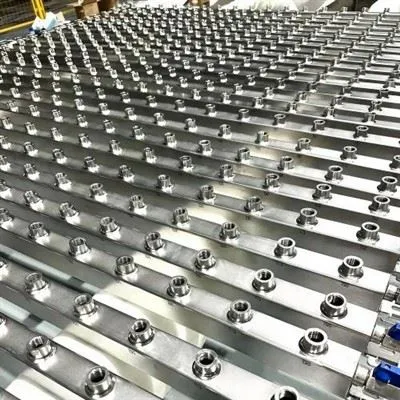
- Manifolds & assemblies: Integrated liquid cooling components
- Surface finish: Polished, pickled, or passivated per application
Customization Process
Requirement confirmation → 2. Solution design (drawing review in 48h) → 3. Prototype (7-10 days) → 4. Mass production → 5. QC & delivery
Applications Across Cooling Infrastructure
| Industry | Typical Application | Recommended Spec | Operating Environment |
| AI Data Centers | Server rack liquid cooling distribution | 316L, 12×12 mm, 1.0 mm wall | Glycol-water coolant, 24/7 operation |
| CDU Systems | Coolant distribution unit manifolds | 316L, 20×20 mm, 1.5 mm wall | High flow rate, pressure cycling |
| Immersion Cooling | Tank-to-heat-exchanger circulation | 316L, 80×80 mm, 3.0 mm wall | Dielectric fluid, long-term immersion |
| Energy Storage | Battery thermal management loops | 304, 10×10 mm, 0.8 mm wall | Pure water / deionized water coolant |
| Industrial Heat Exchange | Process cooling circuits | 316L, 40×40 mm, 2.0 mm wall | Aggressive coolant chemistry |
Customer Cases
- AI Server OEM · Taiwan · 3,200 m · 6-month supply · Batch-to-batch OD variance held at ±0.05 mm across 47 batches - zero installation rework
- CDU Manufacturer · Germany · 850 units · 4-month program · 100% helium leak test passed on every manifold - zero field leaks after 14 months in service
- Data Center Operator · Singapore · 12,000 m · 9-month rollout · Internal Ra 0.4 μm maintained in independent SGS verification - coolant particle count stable for 18 months without filtration upgrade
Customer Voice
- "The biggest concern is not the sample quality, but whether every batch can maintain the same standard." - Procurement Director, AI Server OEM
- "The cheapest supplier is not always the most cost-effective choice. We care more about total project cost." - Engineering Manager, CDU Manufacturer
- "A small leakage problem in liquid cooling can create a very expensive failure." - Thermal Lead, Data Center Operator
FAQ
Q1: What is the internal surface roughness and why does it matter for liquid cooling?
A: Internal roughness is held to Ra ≤0.4 μm, verified per ISO 4287 with a Mahr MarSurf profilometer. Rough surfaces above Ra 0.8 μm create micro-cavities where particles settle, degrade coolant, and eventually clog cold plate microchannels. At Ra 0.4 μm, particle accumulation drops roughly 60%, extending coolant change intervals from 12 to 36 months in AI server applications.
Q2: How do you guarantee leak-free performance in welded joints?
A: We apply orbital welding under ISO 3834 certification - the weld head rotates automatically at controlled speed and current, eliminating the human error variance of manual TIG. Every tube then undergoes 100% helium mass spectrometer leak testing at 1×10⁻⁹ mbar·L/s sensitivity, which detects leaks two orders of magnitude smaller than bubble testing. Statistical sampling is not used - every unit is verified.
Q3: What is the batch-to-batch dimensional consistency?
A: Outer diameter tolerance is held at ±0.05 mm (JIS G3459), verified at each forming stage with CNC-controlled measurement. Because forming, welding, and finishing happen in-house under one responsibility chain, batch-to-batch drift is eliminated. A Taiwan AI server OEM measured ±0.05 mm variance across 47 sequential batches.
Q4: What is the typical lead time for standard and custom orders?
A: Standard tubes ship in 15-20 days. Custom bent tubes and manifolds: 25-35 days including drawing review and prototyping. With 12,000 tons annual capacity and strong inventory, we run three parallel production lines - your order doesn't wait for another customer's to finish.
Key Takeaways
- Internal roughness Ra ≤0.4 μm (ISO 4287) - 3x longer coolant change intervals
- 100% helium leak tested per tube - zero undetected leaks reach your site
- ±0.05 mm dimensional consistency (JIS G3459) - first-fit installation, no rework
- ISO 3834 orbital welding - repeatable weld quality, no operator variance
- 12,000 tons/year capacity - 3 parallel lines, your order doesn't queue
After-Sales Service
- Warranty: 24 months from shipment date
- Technical response: within 24 hours (WhatsApp/Email)
- On-site support: within 72 hours (domestic), remote support worldwide
- Documentation: MTR, inspection reports, and material certs with every batch - full traceability for your compliance file
Logistics & Delivery
- Annual capacity: 12,000 tons - enough pipe to circle a data center campus 3 times over
- Standard lead time: 15-20 days
- Expedited lead time: 10-12 days (available for urgent projects)
- Custom lead time: 25-35 days including prototyping
- Packaging: Anti-corrosion wrapping + sealed export-grade wooden crates - tubes arrive ready for direct integration
- Sample policy: Free samples available, 7-10 days delivery
Request a Quote
Product requirements (spec, quantity, application)
RFQ quick form - engineering response within 24 hours
WhatsApp instant contact - real-time technical discussion
Technical consultation booking - video call with our engineers
Resource download - CAD files (STEP/IGES), technical datasheet
Sample request - 7-10 days to your door
Response commitment: A manufacturer engineer responds within 24 hours - not a sales rep, an engineer who can discuss your coolant chemistry and weld requirements.
Current Q3 production slots are being allocated across active AI infrastructure projects. Submit your spec to confirm capacity for your timeline.