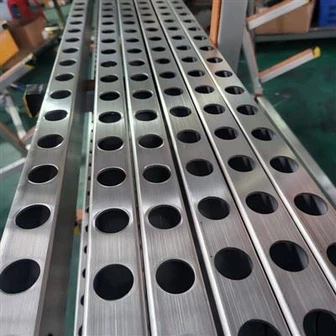
200kW+ AI Racks Are Changing Liquid Cooling Pipe Requirements
AI Data Center Liquid Cooling: 2025 Market Status and Growth Outlook
Hyperscale operators are redesigning entire server racks around direct liquid cooling. The shift is no longer a pilot experiment - it is a procurement standard for next-generation AI infrastructure. Here is where the market stands in 2025.
Why AI Workloads Forced the Transition from Air to Liquid

AI training clusters generate heat densities that air cooling cannot physically remove. A single NVIDIA GB200 NVL72 rack dissipates up to 132 kW. Standard air handling tops out around 30-40 kW per rack before requiring excessive floor space and fan power. The math forces a different approach.
Liquid cooling removes 3,000 times more heat per unit volume than air. This is not an engineering preference - it is a physical constraint. Every major cloud provider has published deployment targets that assume liquid-cooled racks for AI training clusters by 2026.
Market Size Projections for AI Liquid Cooling
The liquid cooling market for data centers is growing at an unprecedented rate. According to industry estimates reported by Grand View Research, the global data center liquid cooling market reached approximately $4.5 billion in 2024 and is projected to expand at a compound annual growth rate exceeding 24% through 2030.
- 2024 market value: ~$4.5 billion (data center liquid cooling segment)
- Projected 2030 value: over $16 billion
- CAGR: 24%+ (2024-2030)
- AI server share of liquid cooling demand: estimated 60%+ by 2026
These figures reflect direct cooling hardware - cold plates, CDUs, manifolds, and the tubing that connects them. The thermal management components segment, which includes stainless steel cooling pipes, represents roughly 25% of the total.
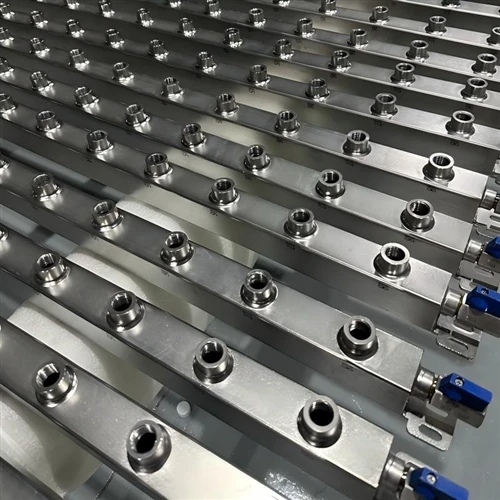
Direct-to-Chip vs Immersion Cooling Adoption
Two liquid cooling architectures dominate the current market. Each matches different deployment scenarios.
| Dimension | Direct-to-Chip (Cold Plate) | Immersion Cooling |
| Coolant type | Glycol-water or pure water | Dielectric fluid (synthetic/PAO) |
| Coolant volume per rack | 10-30 liters | 800-1,500 liters |
| Cooling efficiency | 40-60% energy savings vs air | 50-70% energy savings vs air |
| Retrofitting existing facilities | Possible with CDU integration | Major physical redesign required |
| Adoption stage | Mainstream - hyperscale standard | Early - niche and pilot |
| Typical applications | AI training clusters, HPC | Crypto mining, edge, specialized HPC |
Direct-to-chip dominates because it integrates with existing server form factors. Immersion requires specially designed servers with no air-cooled components, which limits its supply chain compatibility. Most hyperscale deployments in 2025 use direct-to-chip with a coolant distribution unit (CDU) regulating flow and temperature.
The Component Supply Chain: What Procurement Teams Need to Know
The cooling loop is only as reliable as its weakest connection. A micro-leak in a tube weld can shut down a server rack and damage tens of thousands of dollars in GPU hardware. This is why component specifications matter more than in any other cooling application.
Stainless Steel 316L as the Material Standard
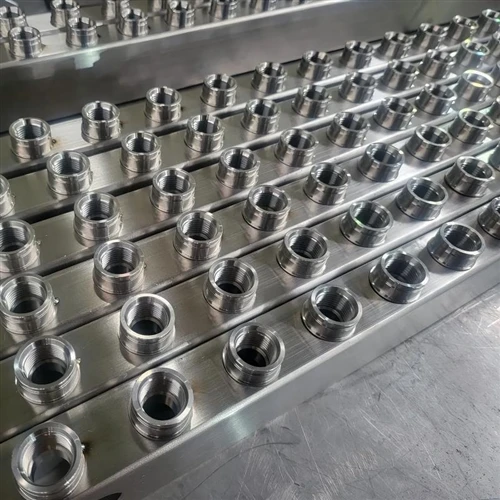
Type 316L stainless steel is the industry reference for liquid cooling tubes. The material's molybdenum content (2-3%) provides pitting resistance in chloride environments, and the low carbon composition (max 0.03%) prevents sensitization during welding.
For procurement teams, the specification points that matter are:
- Internal surface roughness: Ra ≤ 0.4 μm prevents particle accumulation and biofilm formation in the coolant loop
- Dimension tolerance: mating surfaces on the tube and connectors must hold consistent tolerances batch to batch
- Weld quality: orbital welding with controlled heat input minimizes weld bead protrusion into the flow path
- Certification traceability: material mill certificates (MTC) and leak test records must accompany every batch
Regional Demand Trends
North America leads AI infrastructure spending, driven by hyperscaler capital expenditure. Europe follows with stricter energy efficiency regulations (EU Energy Efficiency Directive) pushing liquid cooling adoption. Asia-Pacific, particularly China and Southeast Asia, is scaling AI data centers at a pace that now rivals North America.
Each region has distinct sourcing patterns:
- North America: Prefers suppliers with local warehousing and documented ISO-certified quality systems. Compliance documentation (RoHS, REACH) is mandatory.
- Europe: Requires full material traceability and CE-marked components. German and Nordic operators audit suppliers on-site before qualification.
- Asia-Pacific: Price-sensitive but increasingly quality-focused as AI server density rises. Fast delivery capability is a differentiator.
The 2025-2030 Outlook
The transition to liquid cooling for AI infrastructure is not a trend - it is a structural shift in how data centers are built. The market will consolidate around suppliers who demonstrate repeatable quality at scale. Component standardization will increase, but material quality and process control will remain the key differentiators.
Suppliers with certified welding processes (ISO 3834), strict internal cleanliness control, and documented traceability are positioned to capture the majority of hyperscale demand. This is the market reality in 2025 and the trajectory for the rest of the decade.
FAQ
What is driving the shift from air cooling to liquid cooling in AI data centers?
+
-
AI training clusters generate heat densities exceeding 30-40 kW per rack, which is the practical limit for air cooling. Liquid cooling removes approximately 3,000 times more heat per unit volume than air, making it the only viable solution for high-density AI racks such as the NVIDIA GB200 NVL72 at 132 kW per rack.
What are the main liquid cooling types used in data centers?
+
-
Direct-to-chip (cold plate) cooling and immersion cooling are the two main types. Direct-to-chip uses a coolant distribution unit to circulate glycol-water through cold plates attached to server components. Immersion cooling submerges servers in dielectric fluid. Direct-to-chip is the most widely adopted for AI data centers.
Why is 316L stainless steel the preferred material for liquid cooling tubes?
+
-
316L stainless steel contains molybdenum (2-3%) which provides pitting resistance in chloride-containing coolants, and low carbon (max 0.03%) prevents weld sensitization. These properties ensure long-term reliability in glycol-water coolant loops.
What is the projected growth rate for the data center liquid cooling market?
+
-
The market is projected to grow at a compound annual growth rate exceeding 24% from approximately $4.5 billion in 2024 to over $16 billion by 2030, based on Grand View Research industry estimates.
What specifications are critical when procuring stainless steel cooling tubes?
+
-
The critical specifications are internal surface roughness (Ra ≤ 0.4 μm to prevent particle accumulation), dimension tolerance consistency across batches, weld quality (orbital welding preferred), and complete certification traceability including material certificates and leak test records.
If you are evaluating stainless steel liquid cooling tube suppliers for your next AI infrastructure project, request material certifications and batch consistency data before committing volume.