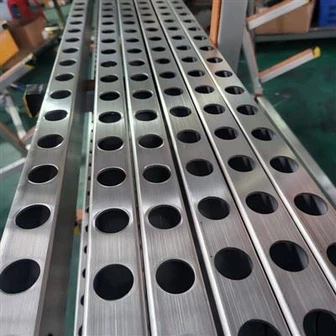
2026 AI Data Center Liquid Cooling Guide: 304 Vs 316L Stainless Steel Cooling Pipes
A single pitting corrosion failure in your CDU manifold can shut down 30-50kW of AI computing capacity for 48-72 hours. Choosing between 304 and 316L stainless steel cooling pipe for data center systems comes down to one variable: what fluid runs through it. Pure water systems perform equally with 304 at lower cost. Glycol mixtures, immersion fluids, and coastal environments require 316L's 2-3% molybdenum content. This guide breaks down the technical, financial, and operational differences to help you specify the correct grade before procurement.
Why Pipe Material Selection Is a 7-Figure Decision
AI training clusters changed the thermal math. A single NVIDIA H100 GPU draws 700W. A fully populated rack hits 30-50kW-five times what air cooling can dissipate. Liquid cooling is the only path to deploying dense GPU clusters.
Inside that liquid loop, the stainless steel cooling pipe for data center infrastructure carries coolant to cold plates, CDUs, and manifold distribution networks. The pipe grade you specify determines whether that loop runs for 15 years or fails in month 18.
A pitting corrosion pinhole in a 304 pipe carrying ethylene glycol at 45°C does not leak slowly. It propagates. Coolant enters the server aisle. GPUs throttle or shut down. In a 50MW facility, 48 hours of downtime at $8-12 per GPU-hour translates to $200,000-400,000 in lost compute revenue.
Pipe grade is specified once-at procurement. Getting it wrong costs 100x more than the pipe itself.
304 vs 316L: Composition and Performance Differences
Both grades are austenitic stainless steels. The difference is one element: molybdenum (Mo). 316L contains 2-3% Mo; 304 contains none. That single addition changes three performance characteristics that matter in data center liquid cooling.
|
Property |
304 (AISI 304/304L) |
316L (AISI 316L) |
|
Composition |
18% Cr, 8% Ni, no Mo |
16% Cr, 10% Ni, 2-3% Mo |
|
Carbon content |
≤0.08% (304L: ≤0.03%) |
≤0.03% (ultra-low carbon) |
|
Corrosion resistance |
Standard for pure water environments |
3-5x better in chloride-bearing environments |
|
Suitable coolant |
Pure water, deionized water |
Ethylene glycol, propylene glycol, chloride-containing fluids |
|
Pitting resistance (PREN) |
~18-20 |
~24-26 |
|
Tensile strength (min) |
515 MPa (ASTM A312) |
485 MPa (ASTM A312) |
|
Yield strength (min) |
205 MPa (ASTM A312) |
170 MPa (ASTM A312) |
|
Cost index |
Baseline (100) |
120-140% of 304 |
|
Best fit |
Closed-loop pure water systems, indoor data centers |
AI training clusters, immersion cooling, high-chloride water regions |
The tensile strength numbers may look like 304 is stronger. It is-by 30 MPa. But in liquid cooling applications, pipe failure is not caused by tensile overload. It is caused by pitting corrosion and chloride stress corrosion cracking. And in those failure modes, 316L outperforms 304 by a factor of 3-5x, according to ASTM G48 pitting resistance testing.
PREN (Pitting Resistance Equivalent Number) is the industry-standard metric for ranking stainless steel corrosion resistance in chloride environments. The formula: PREN = %Cr + 3.3 × %Mo + 16 × %N. 304 scores 18-20. 316L scores 24-26. A PREN above 24 is required for sustained exposure to chloride-bearing coolants.
Coolant Chemistry Determines Pipe Grade-Not Budget
This is the section that determines your specification. Three coolant types dominate AI data center liquid cooling:
1. Pure Water / Deionized Water
Electrical resistivity >1 MΩ·cm. No chloride content. 304 performs identically to 316L in this fluid-corrosion rates for both grades are below 0.01 mm/year at 40°C (per ASTM G31 immersion testing). Specifying 316L for a pure water system adds 20-40% material cost with zero performance benefit. 304 is the correct choice.
2. Ethylene Glycol / Propylene Glycol Mixtures (25-50%)
Glycol mixtures are used in data centers where freeze protection or wider operating temperature ranges are required. Commercial glycol inhibitors contain chloride ions as stabilizers-typically 5-50 ppm. At 45°C operating temperature, this chloride concentration is sufficient to initiate pitting in 304 within 18-36 months. 316L's molybdenum content forms a passive MoO₄ layer that resists chloride penetration. 316L is mandatory for glycol systems.
3. Immersion Cooling (Dielectric Fluids)
Single-phase and two-phase immersion cooling uses synthetic dielectric fluids (e.g., 3M Novec, Shell Diala). These fluids are chemically inert to stainless steel, but immersion systems operate at 50-70°C for 10+ years continuous service. Long-term thermal exposure degrades 304's passivation layer faster than 316L's. For 15-year service life in immersion, 316L is the industry recommendation (per ASHRAE TC 9.9 guidelines).
Decision Matrix: Which Grade for Your Facility
Six common deployment scenarios. Match your facility to the row.
|
Scenario |
Recommended grade |
Why |
|
AI training cluster (GPU >700W per chip) |
316L |
Glycol mixtures + high temp cycling demand Mo-alloy protection |
|
Immersion cooling (dielectric fluid) |
316L |
Long-term chemical exposure requires maximum corrosion resistance |
|
Closed-loop pure water CDU |
304 |
Pure water has no chloride-304 performs equally at lower cost |
|
Data center in coastal area (Brazil, India, SEA) |
316L |
Atmospheric chloride exposure accelerates 304 pitting |
|
Energy storage system (battery thermal) |
316L |
Glycol coolant + long service life (15+ years) require Mo stability |
|
Budget-constrained indoor facility |
304 |
Adequate for controlled environments with pure water coolant |
Regional Considerations for Target Markets
Geography affects pipe grade selection through two channels: water chemistry and atmospheric chloride exposure.
Brazil and India: Municipal water treatment in many regions does not fully remove chlorides. If your facility uses tap water as makeup water for the cooling loop, chloride accumulation over time shifts the fluid from 'pure water' to 'low-chloride' - 316L becomes the safer specification.
Southeast Asia: Coastal data centers in Singapore, Indonesia, and Malaysia face atmospheric chloride loads of 0.3-1.2 mg/m²/day (per ISO 9223 corrosion classification C4-C5). Even indoor facilities with HVAC filtration face some chloride ingress. 316L is standard practice for coastal SEA facilities.
South Africa: Inland facilities (Johannesburg) can safely use 304 for pure water systems. Coastal facilities (Cape Town, Durban) follow the same atmospheric chloride protocol as SEA.
United States: Most hyperscale facilities in Ashburn, Phoenix, and Dallas use 304 for closed-loop pure water CDUs. Facilities in coastal California or Florida specify 316L for the same systems. The difference is atmospheric chloride exposure, not coolant chemistry.
Procurement Checklist: 7 Questions to Ask Your Supplier
Before issuing a PO for stainless steel cooling pipe for data center systems, verify these 7 items:
1. Material certificate (EN 10204 3.1) showing actual heat analysis-not just grade designation
2. ASTM A312 or A269 compliance for seamless/welded pipe dimensions
3. Intergranular corrosion test (ASTM A262 Practice E) for 316L-confirms carbide precipitation is within limits
4. Surface finish: Ra ≤0.8 μm for cooling pipe internals (rougher surfaces trap particulates and initiate pitting)
5. Pressure test at 1.5x design pressure, held 30 minutes, with documented results
6. ISO 9001 quality management system certification-not just a business license
7. Welding procedure qualification (ISO 3834 or ASME IX) if the supplier provides prefabricated manifolds or spool pieces
If a supplier does not provide items 1-3, you are not buying pipe-you are buying risk.
FAQ
Can I use 304 pipe and upgrade to 316L later if corrosion appears?
No. By the time pitting is visible, the pipe wall has already lost 30-50% thickness at the pit site. Replacement requires draining the loop, cutting pipe sections, welding new segments, pressure-testing, and refilling-a 3-5 day shutdown for a single section. The material savings of 304 vs 316L ($8-15 per meter for DN25 pipe) is insignificant against one shutdown event.
How does 316L's lower tensile strength affect system design?
316L yields at 170 MPa vs 304's 205 MPa (ASTM A312). For standard data center operating pressures (2-6 bar), both grades have 10x+ safety margin. The strength difference only matters in high-pressure applications (>50 bar), which do not exist in liquid cooling systems.
Is electropolishing necessary for cooling pipe internals?
For 316L in glycol or immersion systems, electropolishing reduces surface roughness to Ra ≤0.4 μm and removes free iron from the surface layer. This extends pitting initiation time by 2-3x. For 304 in pure water systems, mechanical polishing to Ra ≤0.8 μm is sufficient.
What warranty period should I expect from a pipe supplier?
A manufacturer confident in their material certification and welding quality should offer a minimum 5-year warranty against manufacturing defects. 10-year warranties are common for 316L systems with documented ISO 9001 and ISO 3834 compliance. If the supplier offers no warranty, the pipe has no traceability.
Can I mix 304 and 316L in the same cooling loop?
Technically yes-galvanic corrosion between 304 and 316L is negligible in most coolants. Operationally, mixing grades complicates maintenance records and future failure analysis. Best practice: specify one grade per loop. If budget requires 304 for non-critical sections, isolate them with flanged connections and label clearly.
Specify with Confidence
Send your cooling loop specifications-coolant type, operating temperature, pipe diameter, and facility location. You will receive a verified material specification sheet within 24 hours, including grade recommendation, wall thickness calculation, and compliance documentation.
Contact China Super Tech for ISO 9001 / ISO 3834 certified stainless steel cooling pipe manufacturing.
-
China Super Tech Co., Ltd.
316liquidcooling.com - 11 years focused on stainless steel cooling pipe for data center and energy storage systems. ISO 9001 / ISO 14001 / ISO 45001 / ISO 3834 / CE / RoHS certified. Beijing headquarters, serving North America, South America, India, Southeast Asia, and South Africa.
Contact: sales@316liquidcooling.com | +86 159 0035 7871 | WhatsApp: +86 159 0035 7871
Address: Wangjing Science and Technology Park, Guangshun North Street, Chaoyang District, Beijing, China