Why Use 316 Liquid Cooling Manifold For Data Center Cooling
Precision Flow Distribution for High-Density Cooling
The efficiency of a liquid cooling loop depends on how evenly coolant reaches every heat-generati...
Balanced pressure drop across all ports - tested at 0.5 MPa differential pressure, flow variation between ports stays within ±3%. This consistency means each connected server rack receives identical coolant volume, eliminating hot spots that degrade component lifespan. Dimensionally stable connections - manifolds are manufactured with outer diameter tolerance of ±0.1 mm per ASTM A312, ensuring O-ring seals compress uniformly. A consistent seal line prevents micro-leakage that standard industrial manifolds often develop after thermal cycling. Smooth internal surfaces - internal roughness is controlled to Ra ≤0.4 μm through electropolishing. Smoother walls reduce pressure loss from friction and minimize particle trapping points, keeping the entire cooling loop cleaner for longer.
For engineers, these numbers translate directly into system predictability. Your thermal simulation results will match real-world performance - no unexplained temperature deviations during peak loads.
For project managers, even flow distribution means fewer field adjustments and shorter commissioning time. The manifold performs as specified from day one, not after iterative troubleshooting.
Corrosion Resistance That Protects Long-Term Assets
Liquid cooling loops circulate coolant continuously, often at elevated temperatures. Over years of operation, even minor corrosion releases particles that clog micro-channels in cold plates and erode pump seals. The material choice for your manifold determines whether your cooling infrastructure degrades gracefully or fails catastrophically.
316L stainless steel construction - the low carbon variant (≤0.03% C) prevents carbide precipitation at weld zones per ASTM A312/A312M. This means the heat-affected zone retains the same corrosion resistance as the base metal, even in the glycol-water mixtures common in data center cooling. Passivated surface layer - after welding, every manifold undergoes pickling and passivation to restore the protective chromium oxide layer. This passive film self-repairs when exposed to oxygen, providing continuous protection against pitting and crevice corrosion. Verified coolant compatibility - tested with propylene glycol and ethylene glycol solutions at concentrations from 20% to 50% by volume, at operating temperatures up to 85°C, for 1000-hour immersion cycles. Post-test examinations confirm no pitting initiation, no discoloration, and no measurable weight loss.
Engineers comparing material options will note that 316L outperforms 304 in chloride-containing environments - relevant when coolant quality varies across seasons or when make-up water introduces impurities. This specification removes a variable from your system reliability equation.
Facility managers avoid the hidden cost of premature replacement. Manifolds remain serviceable for the full system design life, eliminating mid-life retrofits that disrupt operations.
Welding Integrity Eliminates Leak Points
Every welded joint in a liquid cooling system is a potential failure point. A single micro-leak in a manifold can drip coolant onto server components, causing short circuits and expensive downtime. Welding quality - not material grade - is the primary variable separating manifolds that last from those that fail.
ISO 3834-certified welding processes - the certification covers welding procedure specifications, operator qualifications, and quality control procedures. This provides documented assurance that every weld meets a defined standard, not just the skills of an individual welder on a particular day. Orbital welding for consistent penetration - automated orbital welding eliminates the variability of manual TIG welding. Machine-controlled arc travel produces uniform weld bead geometry every time, with full penetration and no tungsten inclusions. 100% leak testing before shipment - every manifold undergoes either hydrostatic testing at 1.5× working pressure or helium leak detection with a sensitivity threshold of 1×10⁻⁹ mbar·L/s. Product documentation includes the test method, test pressure, and acceptance criteria for each unit.
This approach eliminates the scenario where a manifold arrives on site and the cooling loop cannot be pressurized because of a hidden defect. The hydraulic test at your facility becomes a formality, not a discovery process.
Project schedules remain intact because there is no rework loop. No weld repair, no re-testing, no waiting for replacement units while your commissioning timeline slips.
Full Customization Without Standard Part Limitations
Standard off-the-shelf manifolds force design compromises. You either adjust your piping layout to fit available port configurations, or you accept extra fittings that add potential leak points and pressure losses. Custom manufacturing removes these constraints.
Custom material grades - choose 304 stainless steel for pure water and deionized water systems where cost efficiency matters, or 316L for glycol-based coolants and environments with higher corrosion potential. Both grades are available with full material traceability. Custom dimensions and configurations - manifolds can be manufactured in a wide range of sizes and layouts:
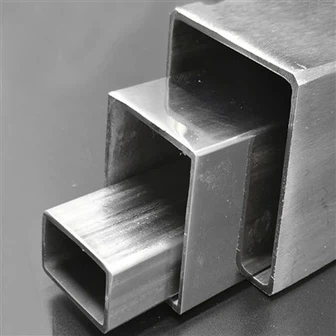
Pipe dimensions from 10×10 mm up to 80×80 mm square sections and equivalent round sizes
Wall thickness options from 0.5 mm to 3.0 mm to match your working pressure requirements
Manifold lengths up to 6000 mm to accommodate large server halls and high-density layouts
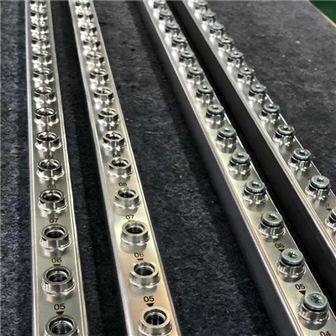
Custom inlet/outlet positions, port angles, and connector types to match your specific equipment interfaces
Integrated bends and custom assemblies that reduce the number of field joints
Engineering review before production - a technical team reviews your drawings, confirming dimensions, connection methods, and application conditions before any material is cut. This catches design issues that would otherwise surface during installation.
For engineers, custom manifolds mean the piping design in your CAD model is buildable as designed. No adaptation, no field compromises.
Procurement teams reduce their supplier base by consolidating custom manifold orders with a manufacturer that handles both standard tubes and specialized components.
Consistent Batch Quality for ISO 9001 certified Supply
The risk with any new supplier is sample quality that does not persist through production volumes. When you scale from prototype validation to thousands of units, dimensional drift or material variation becomes a costly field problem. Manufacturing discipline determines whether batch #50 performs identically to batch #1.
Integrated production control - raw material inspection, tube forming, welding, surface treatment, machining, inspection, and assembly are all performed in-house. No external processing steps introduce variability or require coordination across multiple factories. Incoming material verification - every material batch undergoes spectrometer testing to verify chemical composition per ASTM A312, before any tube is formed. This prevents substandard material from entering production. Multi-stage quality gates - dimensional measurements, weld inspections, surface roughness checks, and pressure tests are conducted at defined stages throughout production, not just at final inspection. Defects are caught at the process step where they originate, before they compound. Full documentation package - each shipment includes material test certificates, dimensional inspection reports, welding documentation, and test results. This documentation satisfies the requirements of quality audits and third-party verification, helping your team complete supplier qualification faster.
The consistency that results from this process control means your assembly line experiences no surprises. Each manifold installs the same way, connects to the same interfaces, and performs to the same specification as the last one.
Operations teams avoid the waste of production line stoppages caused by out-of-tolerance components. Installations proceed smoothly, and planned maintenance schedules are met without exception.
12,000 Tons Annual Capacity for Scalable Delivery
Project timelines in data center construction are rarely flexible. Server delivery dates are set, power infrastructure is commissioned, and cooling systems must be ready when the facility goes live. Production capacity determines whether your supplier can actually deliver at the volume you need, when you need it.
Production stability for large projects - with 12,000 tons of annual stainless steel pipe production capacity, the factory can absorb large-volume orders without disrupting existing customer commitments. The manufacturing capability supports everything from pilot quantities to full-scale deployment. 11+ years of manufacturing experience - processes are refined and stable. Production teams have encountered and solved the manufacturing challenges that arise in liquid cooling components, from thin-wall welding distortion to tight-tolerance bending. Exports to 20+ countries - the factory has experience navigating international shipping requirements, export packaging standards, and documentation needs across multiple markets. This reduces friction in the delivery process. 7–15 working days standard lead time - for orders within standard specification ranges, production slots are typically available to meet standard lead times. Your project does not wait weeks for a production window. 30% faster delivery capability for urgent projects - when schedules compress, flexible production coordination enables expedited delivery for time-sensitive requirements.
Project managers can plan with realistic delivery commitments. The procurement risk of supplier capacity shortages is removed - this factory has the scale to meet committed dates.
Lower Total Cost Through Longer Service Life
Procurement decisions based solely on unit price overlook the costs that accumulate over a cooling system's operational life. A manifold that costs 10% more upfront but lasts twice as long and requires no maintenance delivers a lower total cost - and eliminates the operational disruption of premature replacement.
Reduced maintenance requirements - smooth internal surfaces resist particle accumulation, which means less frequent cleaning and longer intervals between coolant changes. The corrosion-resistant surface does not degrade, so system performance remains stable without intervention. Fewer failure-related costs - the primary cost of manifold failure is not the replacement part; it is the downtime, troubleshooting labor, and potential damage to connected components. Consistent welding quality and 100% leak testing minimize this risk. Longer replacement cycles - when the entire cooling system approaches its design life, the manifold can typically be reused or refurbished rather than replaced. This extends the useful life of the cooling infrastructure. No hidden compliance costs - full documentation including ISO9001 quality management system certification, ISO3834 welding quality certification, CE, and RoHS compliance means your quality audit team does not spend weeks chasing missing documentation from the supplier. Quality verification support - inspection reports and product documentation are provided according to customer requirements, supporting your internal approval processes without friction. Sample availability before mass production - validate product quality and dimensions before committing to bulk orders. For new designs, small-batch trial production is supported to verify manufacturability prior to volume ramp.
This long-term cost picture is the reason experienced cooling system buyers prioritize manufacturing discipline over unit price. The cheapest option at purchase is rarely the least expensive option when measured over the full system lifecycle.
FAQ
Q1: What is the difference between 304 and 316L stainless steel for liquid cooling manifolds?
A: The difference is corrosion resistance in specific environments. 304 stainless steel is suitable for pure water and deionized water cooling systems, where it offers adequate corrosion protection at lower cost. 316L stainless steel (with max 0.03% carbon content) provides superior corrosion resistance in chloride-containing environments such as glycol-water coolants, which are common in AI data center cooling. Because 316L has low carbon content, it also prevents carbide precipitation at weld zones, maintaining corrosion resistance even after welding. For long-term system reliability in demanding coolant conditions, 316L is the recommended choice.
Q2: What is the minimum order quantity (MOQ) and lead time?
A: Sample orders are available for product evaluation before mass production. For standard products within regular specification ranges, standard lead time is 7–15 working days. Customized products require engineering review of drawings and specification confirmation, with lead time varying based on complexity. For urgent projects, expedited delivery is available with up to 30% faster turnaround through flexible production scheduling. With 12,000 tons of annual production capacity and integrated in-house manufacturing, the factory can support both small pilot orders and large-volume continuous supply programs.
Q3: How do you ensure batch-to-batch consistency for large orders?
A: Consistency is ensured through full in-house process control and multi-stage quality inspection. Every raw material batch is verified with spectrometer testing for chemical composition, so no substandard material enters production. Dimensional measurements, weld inspections, and surface checks are conducted at defined process stages. Final pressure testing and leak detection are performed on 100% of production units. This comprehensive quality control ensures that batch #50 performs identically to batch #1, which directly addresses the common industry problem of sample quality not persisting through production volumes.
Request a Quote
Send the following information to receive a detailed quotation from a liquid cooling engineer:
Company name and contact email
Product specifications: material grade, dimensions, quantity, and drawings if available
Application details: cooling loop type, coolant composition, operating pressure and temperature
Response commitment: A manufacturer engineer responds within 24 hours with technical confirmation and quotation.
RFQ quick form - submit specifications for a detailed quote
WhatsApp instant contact - connect directly with the sales engineering team
Technical consultation - discuss your cooling system requirements before ordering
Sample request - evaluate product quality with sample orders
Documentation center - request material certificates and test reports
Current production slots for Q3 are being allocated across ongoing liquid cooling projects. Submit your inquiry to confirm availability for your required delivery date.