



Server Liquid Cooling Manifold
Our Server Liquid Cooling Manifolds are specifically engineered to support demanding data center environments where uptime, thermal consistency, and operational safety are non-negotiable. Manufactured from premium stainless steel and processed with high-precision fabrication technologies, these manifolds provide dependable fluid delivery between the CDU and server-level cooling loops. In high-density liquid cooling systems, the manifold acts as the central fluid distribution hub. Any instability, leakage, or uneven flow can directly affect server performance and operational continuity. That’s why every manifold we produce is built around long-term reliability, flow consistency, and leak prevention.
Product Introduction
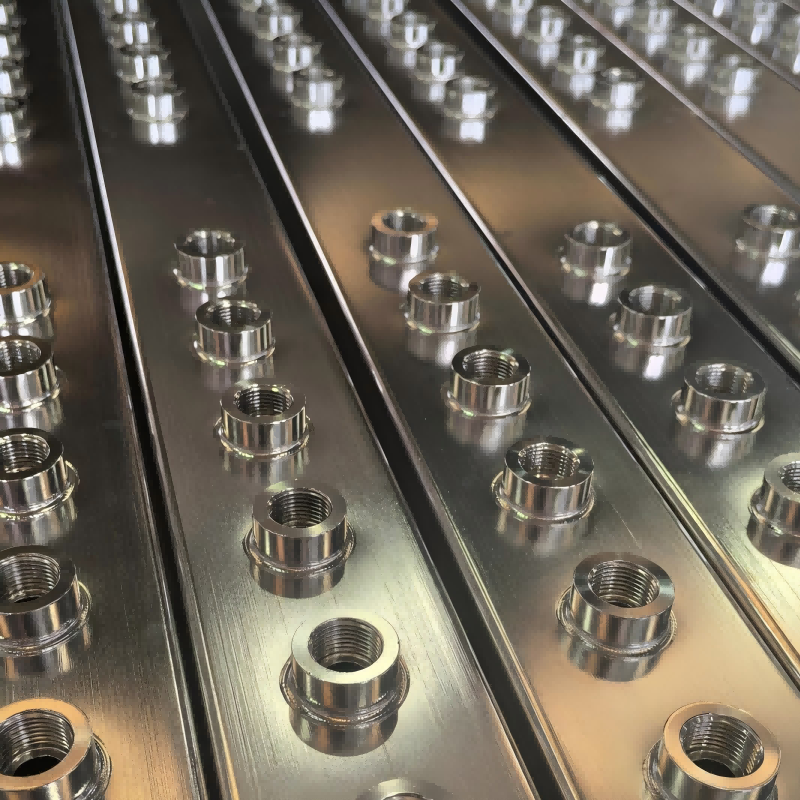
A Server Liquid Cooling Manifold is a 304/316L stainless steel distribution assembly that routes coolant from a CDU to individual server racks in AI data center and immersion cooling systems. Built to ASTM A312 and JIS G3459 with internal surface roughness down to Ra ≤0.4 μm, ISO 3834-certified orbital welding, and 100% pre-shipment leak testing. One manifold replaces up to 12 field-welded joints - cutting installation time and leak points in the same move.
[Product image: full-view Server Liquid Cooling Manifold with integrated branch outlets and orbital-welded connections]
ISO 9001 · ISO 14001 · ISO 45001 · ISO 3834 · CE · RoHS | 11+ years · 12,000 tons/year · 20+ countries · 600+ projects
[Get a Quote] - engineering reply within 24 hours
What a Failing Manifold Actually Costs Your Project
A sample-approved manifold arrives with 0.4 mm OD drift on batch 2 - 30 rack connections no longer seat, and rework runs 2 weeks past your go-live date.
Weld bead geometry shifts between batches, so your leak test catches defects only after 40 units are already assembled into racks.
Head loss climbs past your CDU pump curve because internal roughness varies unit to unit - flow balance per rack moves outside the design window.
A data center infrastructure lead evaluating a cooling upgrade put the risk plainly: "Our existing rack design has very limited installation space, and standard liquid cooling components don't fit without rework."


Why Batch Consistency Breaks Down
Heat input drifts across a production run when welding is done freehand, so penetration depth and bead width vary from unit to unit.
Material traceability stops at the mill certificate, so a substituted heat number reaches your line without a chemical composition re-check.
Final leak testing samples a portion of the run instead of every unit, leaving the undocumented defects for your commissioning team to find.
A Server Liquid Cooling Manifold produced under a controlled process holds the same dimensional and metallurgical result across batch 1 and batch 40.
Differentiation: This Manifold vs Industry Conventional
| Dimension | This product | Industry conventional | Differential value |
| Internal roughness | Ra ≤0.4 μm (polished, pickled, passivated) | Ra 1.6–3.2 μm typical | Cuts particle accumulation sites, extends coolant life |
| Weld quality control | ISO 3834-certified orbital welding, 100% leak tested | Manual TIG, sampled leak testing | Leak points per manifold reduced to zero field welds |
| Material verification | Chemical composition re-check per batch, ASTM A312 grade control | Mill certificate only | Batch-to-batch corrosion performance stays stable |
| Dimensional consistency | ±0.1 mm OD, ±0.05 mm wall across batches | ±0.3 mm OD typical | Rack connections seat on first assembly |
| Standard compliance | ASTM A312 + JIS G3459, CE/RoHS | Varies by supplier | Drop-in fit to international CDU interfaces |
| Custom geometry | 10×10–80×80 mm, 0.5–3.0 mm wall, up to 6000 mm | Standard straight tube only | Eliminates adapter fittings in tight rack space |
Manufacturing Process
- Raw material verification → ASTM A312 / JIS G3459 grade check → spectrometer composition analysis → 304 or 316L confirmed before forming
- Tube forming → dimensional control → precision tube forming equipment → OD and wall tolerance held to ±0.1 mm / ±0.05 mm
- Controlled welding → ISO 3834 orbital welding → automated welding system → consistent penetration and bead geometry across the run
- Internal surface treatment → polishing, pickling, passivation → surface line → Ra ≤0.4 μm verified by profilometer
- Leak and pressure testing → 100% inspection → pressure test bench → every unit tested before shipment
Internal surface quality matters more than most buyers assume. Under Ra ≤0.4 μm, the flow path stays smooth enough that particle accumulation drops and coolant circulation holds steady across years of operation - where conventional industrial tubing at Ra 1.6–3.2 μm gives contamination a place to settle.
Core Components
- Orbital-welded tube joints: automated orbital welding heads, ISO 3834 process control - chosen because manual weld inconsistency is the leading cause of manifold leakage in field data.
- 316L stainless steel body: molybdenum-bearing, low-carbon grade - chosen for pitting resistance in chloride and glycol-based coolant environments.
- Passivated internal surface: nitric/citric passivation line - chosen to remove free iron and restore the chromium oxide layer after machining.
- Integrated branch fittings: CNC-machined connection ports - chosen to eliminate field welding between manifold and rack drop lines.
Quality Inspection
- Incoming inspection → chemical composition + material certificate → spectrometer report per batch
- In-process inspection → dimensional measurement → OD/wall/length per drawing tolerance
- Weld inspection → visual + penetration check → ISO 3834 acceptance criteria
- Surface inspection → roughness measurement → Ra ≤0.4 μm sign-off
- 100% leak test → pressure hold → zero-leak acceptance before shipment
Defect rate held below 0.3% across production. Third-party verification available through SGS/TÜV/BV on request, with inspection reports issued per order.
Technical Specifications
| Category | Parameter | Value | Standard |
|---|---|---|---|
| Dimensional | Square tube size | 10×10 mm to 80×80 mm | Custom |
| Dimensional | Wall thickness | 0.5–3.0 mm | Custom |
| Dimensional | Length | Up to 6000 mm | Custom |
| Material | Grade options | 304 / 316L stainless steel | ASTM A312 |
| Material | Form | Straight tube, bent tube, manifold assembly | JIS G3459 |
| Surface | Internal roughness | Ra ≤ 0.4 μm | Profilometer verified |
| Surface | Treatment | Polishing, pickling, passivation | Internal spec |
| Surface | Cleanliness | Particle-controlled, clean packaging | Internal spec |
| Mechanical | Weld method | Orbital welding | ISO 3834 |
| Mechanical | Leak integrity | 100% pre-shipment tested | Pressure hold |
Customization Capability
| Custom dimension | Range / Options | Verification |
| Tube cross-section | 10×10 mm to 80×80 mm square, round available | Dimensional inspection |
| Wall thickness | 0.5–3.0 mm | ±0.05 mm tolerance |
| Length | up to 6000 mm | Per drawing |
| Geometry | Custom bends, branch outlets, manifold assemblies | Drawing-based review |
| Connections | Customized port sizing and spacing | Fit check per drawing |
Applications Across Cooling Systems
| Industry | Typical application | Recommended spec | Operating environment |
| AI data centers | Rack-level coolant distribution from CDU | 316L, Ra ≤0.4 μm, custom bends | Glycol coolant, continuous 24/7 |
| Immersion cooling | Manifold feeding single-phase immersion tanks | 304/316L, 80×80 mm | Dielectric fluid exposure |
| Energy storage cooling | Battery thermal management distribution | 304, 10×10–40×40 mm | Glycol-water mix, vibration |
The 316L option is the specified choice where coolant carries chloride or glycol; 304 covers pure-water and deionized-water loops at lower cost. Because the manifold can be formed to fit the rack envelope rather than the rack adapting to standard pipe, installers working inside tight rack clearances skip the adapter fittings entirely.

Customer Cases
A data center infrastructure team in Southeast Asia, running rack-level distribution across a retrofit project - reported zero field-weld leaks at commissioning after switching from sampled to 100% leak-tested manifolds.
A CDU system integrator in Germany, sourcing 316L manifold assemblies since 2022 - held batch-to-batch dimensional consistency within ±0.1 mm across repeat orders.
An energy storage thermal management provider in Australia, using 304 manifolds in battery cooling loops - cut installation labor by removing on-site adapter welding.
What Buyers Ask Before Committing
Q: How does the manifold ensure batch-to-batch consistency?
A: Every batch runs the same controlled process: spectrometer composition re-check on incoming material, dimensional control during forming, ISO 3834 orbital welding, and 100% leak testing before shipment. That process discipline keeps OD within ±0.1 mm and wall within ±0.05 mm from the prototype batch to volume production.
Q: What is the standard lead time?
A: Standard products ship in 7–15 working days. Customized manifold assemblies with non-standard bends or port layouts are quoted after drawing review, and urgent projects can see 30% faster delivery through production scheduling adjustment.
Q: What is the minimum order quantity?
A: MOQ depends on the configuration. Standard tube sizes start at small batch quantities, while custom manifold assemblies are quoted per project. Samples are available before mass production so you can verify dimensions and performance first.
Q: Can you supply 316L grade specifically for glycol coolant?
A: Yes. 316L with molybdenum content and low carbon delivers improved pitting resistance and long-term coolant compatibility compared to 304, and it is the recommended grade for glycol-based and chloride-bearing coolant environments. Material is verified per ASTM A312 with a composition report per batch.
Q: How is leakage controlled during production?
A: Welding uses orbital technology under ISO 3834 process control to hold consistent penetration and bead geometry, and every unit passes a pressure-hold leak test before shipment. There is no sampled testing - 100% of production is tested.
Q: What documentation comes with an order?
A: Each order includes material certificates with chemical composition reports, dimensional inspection records, surface roughness verification, and leak test results. Third-party inspection through SGS/TÜV/BV is available for buyers who need independent verification.
Q: How do you handle custom dimensions that must fit existing rack space?
A: Send your drawing or CAD file for a technical review covering tube dimensions, bend requirements, connection methods, and application conditions. Most projects start with a prototype or sample order so fit is confirmed before volume production begins.
Hot Tags: server liquid cooling manifold, China server liquid cooling manifold manufacturers, suppliers, factory, chemical cooling manifold, closed loop manifold system, heat transfer manifold, high tolerance smooth tube, low temperature manifold, machined cooling manifold
You Might Also Like




Send Inquiry
