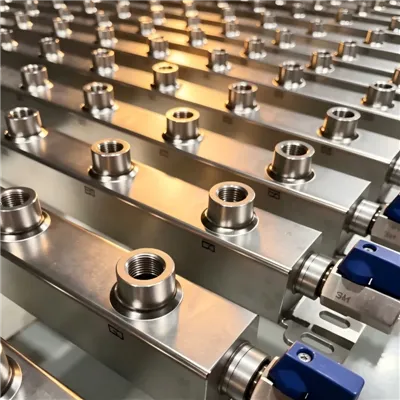
316 Vs 304 Liquid Cooling Manifolds: Material Selection Guide For AI Data Center Cooling
316 vs 304 Liquid Cooling Manifolds: Material Selection Guide for AI Data Center Cooling
When you're building an AI data center liquid cooling system, the manifold material choice isn't a minor detail - it's the difference between a system that runs for a decade and one that fails during peak compute loads. Here's what you need to know before you issue that RFQ.
Why Material Selection Matters More Than You Think

Your liquid cooling manifold sits at the heart of your thermal management system. It distributes coolant to every server rack, every CDU, every cold plate. Choose the wrong material, and you're not just buying tubing - you're buying downtime risk.
The two materials dominating this space are 316L and 304 stainless steel. Both work. Neither is universally "better." The right choice depends on your coolant chemistry, operating environment, and system design life.
Here's the practical difference: 316L contains molybdenum (2.0-3.0%), which 304 doesn't have. That single element changes how the material behaves in corrosive environments - particularly with glycol-based coolants that break down over time and form corrosive byproducts.
316L vs 304: The Material Comparison
| Dimension | 316L Stainless Steel | 304 Stainless Steel | Recommendation |
| Molybdenum content | 2.0-3.0% (ASTM A312) | None (ASTM A312) | 316L for corrosive coolants |
| Chloride stress corrosion resistance | Superior - resists pitting in chloride environments | Moderate - susceptible to pitting in high-chloride conditions | 316L for coolant loops with chloride contamination risk |
| Glycol coolant compatibility | Withstands acidic byproducts from degraded glycol | Requires stable coolant chemistry and maintenance | 316L for AI data centers with long maintenance cycles |
| Cost per meter | Higher (18-25% premium over 304) | Lower | 304 for pure water / deionized water systems |
| Weldability for manifolds | Excellent with ISO 3834 controlled processes | Good - slightly less forgiving in weld heat input control | Both work; 316L more forgiving in weld zones |
| Typical application | AI data centers, CDU systems, immersion cooling | Energy storage, pure water cooling loops | Match to your coolant and risk tolerance |
The recommendation column matters because liquid cooling systems aren't static. Coolant chemistry changes over time. Glycol degrades. Contaminants enter the loop. Your manifold material needs to tolerate those changes without failing.
The Cost Question: What You Actually Pay Over the System Life

Here's where most buyers get it wrong. They compare the per-meter price of 316L and 304 and stop there. That's not the real cost.
Consider what actually happens in a liquid cooling system:
316L manifold: Higher upfront cost. Lower corrosion risk over 10+ years. Fewer unplanned maintenance events. Coolant replacement cycles extend because the system doesn't degrade the coolant as fast.
304 manifold: Lower upfront cost. Higher corrosion risk if coolant chemistry drifts. More frequent coolant testing and replacement. Potential for pinhole leaks in weld zones after 5-7 years.
A distributor supplying manifolds to an AI data center project in Singapore reported the math clearly:
"The cheapest supplier is not always the most cost-effective choice. We care more about total project cost."
The total project cost calculation includes:
- Manifold material cost
- Installation labor (same for both materials)
- Coolant replacement frequency (higher for 304 systems)
- Unplanned downtime risk (higher for 304 in demanding environments)
- System redesign cost if corrosion forces early replacement
For an AI data center where a single hour of downtime costs more than the entire manifold material difference, 316L often wins on total cost of ownership - even at a 25% higher material price.
How to Decide: A Decision Framework for Your Cooling System
Scenario 1: AI Data Center with Glycol-Based Coolant
Your coolant loop uses 25-30% propylene glycol or ethylene glycol. Server density is high. The system runs 24/7 with planned maintenance windows only twice a year.
Choose 316L. Here's why: glycol degrades over time and forms acidic byproducts - primarily glycolic and formic acid. In the presence of chlorides from water impurities, this creates a corrosive environment that attacks standard stainless steel. The molybdenum in 316L provides the pitting resistance that handles this chemistry.
Internal surface finish matters too. Look for manifolds with internal surface roughness Ra ≤0.4 μm. This matters because smoother surfaces resist particle accumulation, which reduces localized corrosion sites and maintains stable coolant circulation.
Scenario 2: Energy Storage System with Pure Water Coolant
Your system uses deionized or pure water. Cooling loads are moderate. The system design includes regular water quality monitoring.
304 is acceptable. In a controlled pure water environment, 304 provides adequate corrosion resistance at lower cost. Many energy storage thermal management systems operate successfully with 304 manifolds because the water chemistry is stable and monitored.
But check your water quality monitoring protocol. If you can't guarantee consistent water chemistry, the cost premium for 316L is worth the insurance.
Scenario 3: Immersion Cooling with Dielectric Fluid
You're using a dielectric coolant for immersion cooling. This fluid is chemically stable and non-corrosive.
Both materials work. The deciding factor becomes system pressure requirements and long-term chemical compatibility testing. Verify that your chosen manifold supplier has documented compatibility data for your specific coolant.
Batch Consistency: The Hidden Quality Factor

Here's what separates a reliable manifold supplier from one that causes production headaches - and it's not just material grade.
A customer in the AI server cooling industry put it this way:
"The biggest concern is not the sample quality, but whether every batch can maintain the same standard."
When you buy liquid cooling manifolds in volume, you're buying consistency:
- Dimensional consistency: Outer diameter tolerance, wall thickness uniformity, and interface positioning must hold across batches. A deviation of even 0.1 mm in interface position can prevent installation into existing cooling modules.
- Welding consistency: Weld zone quality must be uniform. Inconsistent weld penetration creates weak points that fail under pressure.
- Surface finish consistency: Internal roughness that drifts between batches affects coolant flow characteristics and contamination risk.
The manufacturer's process control matters more than the material grade itself. Look for suppliers that integrate material inspection, tube forming, welding, surface treatment, and final inspection in-house, rather than outsourcing different production steps.
Suppliers without in-house testing capability may miss batch defects. Products that pass sample evaluation but drift in mass production create hidden costs - rework, installation delays, and project schedule slip.
What to Verify Before You Buy
Material Certification
Your manifold supplier should provide material certificates with every batch. This isn't optional paperwork - it's your verification that you got the grade you paid for.
For safety-critical cooling applications, you need:
Material certificates per ASTM A312
Chemical composition reports
Test reports for mechanical properties per ASTM A370
RoHS and REACH compliance documentation
ISO 3834 welding quality certification
If a supplier can't provide complete documentation, ask yourself why. Liquid cooling systems demand traceability.
Quality Inspection Capability
The right material in the wrong manufacturing process still fails. Verify your supplier performs:
Raw material verification through chemical composition inspection
Dimensional measurement at production checkpoints
Welding inspection per ISO 3834 standards
100% leak testing before shipment - not batch sampling
Internal surface roughness verification per ISO 4287
A small leakage problem in liquid cooling can create a very expensive failure. One pinhole defect in a manifold means system downtime, coolant loss, and potentially damaged server equipment.
Custom Manufacturing Capability
Standard straight tubes don't serve every liquid cooling layout. Your manifold design may require:
Square tubes: 10×10 mm to 80×80 mm
Wall thickness: 0.5–3.0 mm
Lengths up to 6000 mm
Custom bends, manifolds, and integrated assemblies
The ability to manufacture customized manifolds in-house means shorter development cycles and better coordination on complex designs. A supplier that outsources processing introduces coordination risk - miscommunications between subcontractors lead to dimensional errors and delivery delays.
The Manufacturer's Role in Risk Reduction
You're not just buying material - you're buying the manufacturing discipline that prevents failure. The right supplier reduces your risks across quality, delivery, and documentation.
China Super Tech Co., Ltd. manufactures 304 and 316L stainless steel liquid cooling tubes with:
Internal surface roughness down to Ra ≤0.4 μm - smoother flow paths that reduce particle accumulation
ISO 3834-controlled welding processes, including orbital welding technology, for connection reliability
100% leak inspection before shipment to eliminate leakage risk
Full in-house manufacturing: material inspection, tube forming, welding, surface treatment, machining, and assembly
12,000 tons annual production capacity with 11+ years of experience serving 20+ countries
The factory operates under ISO9001 quality management, holds ISO3834 welding certification, and complies with CE and RoHS requirements. At 600+ completed projects, the manufacturing experience shows up in batch consistency - the factor that determines whether your installation goes smoothly or requires rework.
Request a Quote
Sending an inquiry doesn't commit you to anything. It starts a technical conversation.
To get an accurate quotation, include:
Material grade: 304 or 316L
Tube dimensions: outer dimension, wall thickness, length
Quantity required
Application: AI data center, CDU system, energy storage, or other
Custom requirements: bends, manifolds, special interfaces
Response commitment: A manufacturer engineer responds within 24 hours with technical feedback and a preliminary quotation.
Current production slots for Q3 are being allocated based on order volume.
FAQ
Q1: What is the difference between 316 and 304 stainless steel for liquid cooling manifolds?
A: The key difference is molybdenum content - 316 has 2.0-3.0%, 304 has none. Molybdenum provides resistance to pitting corrosion in chloride and acidic environments. For glycol-based coolants that degrade over time, 316 provides better long-term reliability. For pure water systems with monitored chemistry, 304 works at lower cost.
Q2: Which manifold material should I choose for an AI data center cooling system?
A: For AI data center cooling with 25-30% glycol coolant, 316L is the recommended choice. Glycol degrades to acidic byproducts that attack standard stainless steel. The molybdenum in 316L resists this corrosion. For closed systems using pure water with consistent monitoring, 304 provides adequate performance at lower cost.
Q3: How much more does 316L cost compared to 304 stainless steel manifolds?
A: 316L typically costs 18-25% more per meter than 304. However, total system cost depends on coolant chemistry, maintenance schedules, and downtime risk. In demanding environments where 304 would require more frequent coolant replacement or risk corrosion failures, 316L often delivers lower total cost of ownership.
Q4: What certifications should a liquid cooling manifold manufacturer have?
A: Key certifications include ISO9001 quality management, ISO3834 welding quality, CE and RoHS compliance. Material certificates per ASTM A312 and test reports per ASTM A370 should accompany each batch. For critical cooling applications, verify the supplier provides complete quality documentation for supplier audits.
Q5: What is the typical lead time for custom liquid cooling manifolds?
A: Lead times vary by design complexity and order volume. Manufacturers with integrated in-house production respond faster to drawing reviews and prototype requirements than suppliers that outsource processing. For standard sizes, the manufacturer can provide specific lead time based on your order quantity and specifications.
Q6: Can I get samples before placing a bulk manifold order?
A: Most liquid cooling manifold manufacturers provide samples for evaluation. Sample requests should include your specifications - tube dimensions, material grade, wall thickness, and surface finish requirements. The manufacturer can then provide a quote for sample pieces before mass production.